

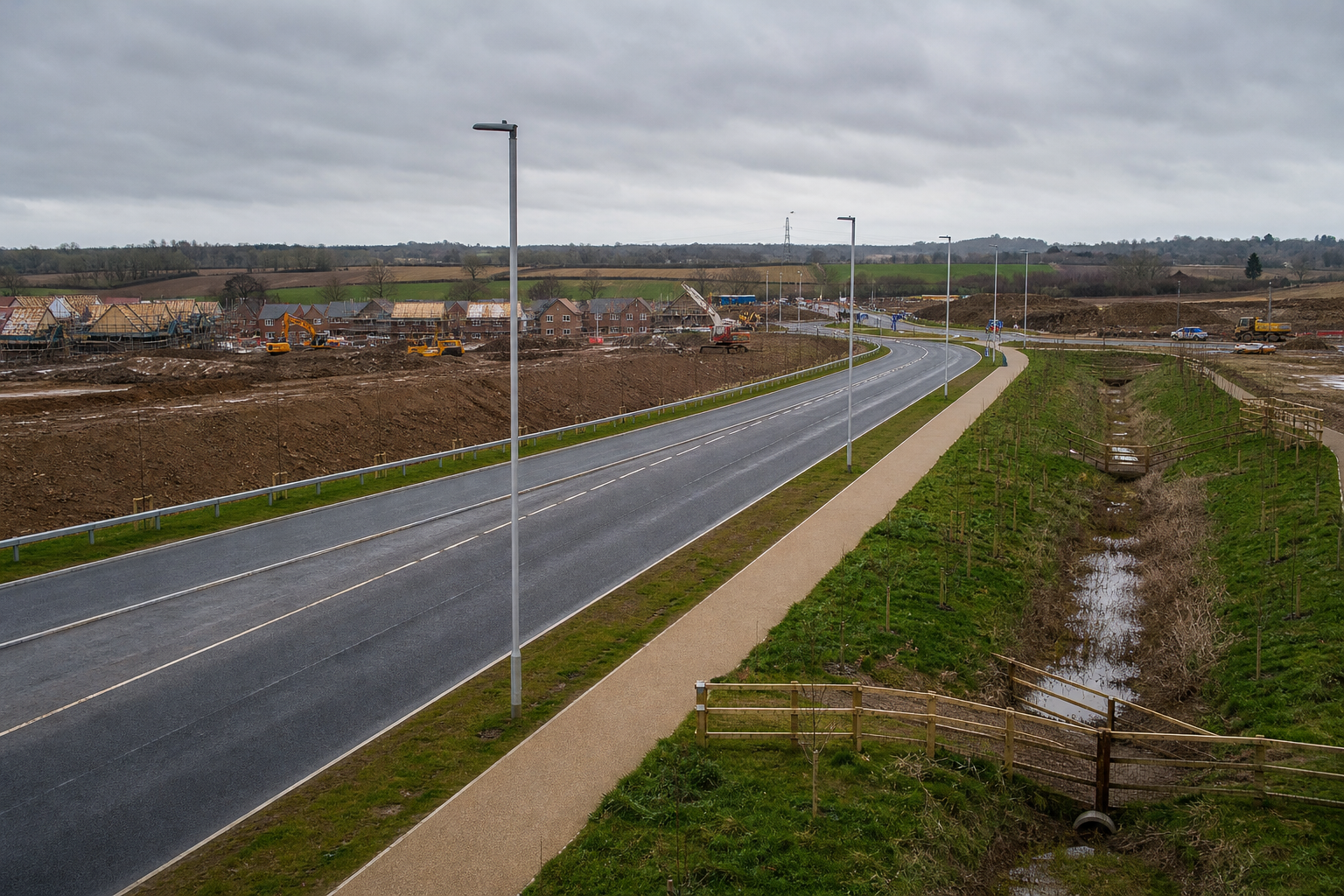
Master planning can help bring forward roads and other infrastructure alongside housing, according to John Eldridge, group director of project management at Urban & Civic.
Eldridge used the company’s Newark development to explain how public-private partnerships can support projects that might otherwise be difficult to finance. The approach comes as the government targets the delivery of 1.5 million homes by 2029.
Public and private funding
The Southern Link Road, which connects the A1 with the A46, opened in April. The £100m scheme was funded through a combination of private and public investment, with Urban & Civic contributing £65m.
The remaining funding comprised £20m from national government, £7m from the local enterprise partnership, £5m from Newark and Sherwood District Council and £3m from Nottinghamshire County Council.
“Effectively, there was leverage to allow us to put in a substantial sum that was viable for us, which was then topped up with the local authority’s money that took us to the pot that allowed us to deliver,” Eldridge said.
He said the partnership avoided placing the full cost on Urban & Civic, which could have made the project unviable, while allowing wider economic and infrastructure benefits to be realised.
For the public sector, Eldridge said the return is expected to come through economic growth, improved transport, job creation and wider regional benefits rather than solely through a financial return. Urban & Civic expects to recover its investment through the sale of development parcels and increased demand for land and homes in the Newark area.
Infrastructure delivered early
Eldridge said the master-planner model can reverse the traditional sequence in which housing is built or sold before major infrastructure is funded. By securing the capital for the link road early, Urban & Civic was able to commit to delivering it alongside the initial development phases.
He said the road has unlocked the delivery of more than 3,000 homes and is expected to support further development over the next five to eight years without requiring additional investment in the link road. The benefits also include employment space, improved connectivity for existing businesses and the potential to attract new businesses.
“Ultimately, we’re not just here to build homes, we’re here to bring schools, community buildings, local investment and economic growth,” Eldridge said.
Early engagement
Urban & Civic said the model also allows project teams to involve highways authorities, environmental bodies, flood authorities, heritage organisations and local communities at an early stage.
Eldridge said discussions with organisations including Natural England and Historic England help inform design codes and planning applications. Early engagement, he argued, can identify concerns around transport, education, recreation, flooding and the historic environment before applications reach council committees.
He described the approach as “a preapp on steroids”, with the aim of reducing delays by ensuring that stakeholders have been involved throughout the planning process.
According to Eldridge, the road is therefore only one part of the wider development outcome. The infrastructure investment is also intended to support schools, community facilities, open space and other services required by a growing settlement.