

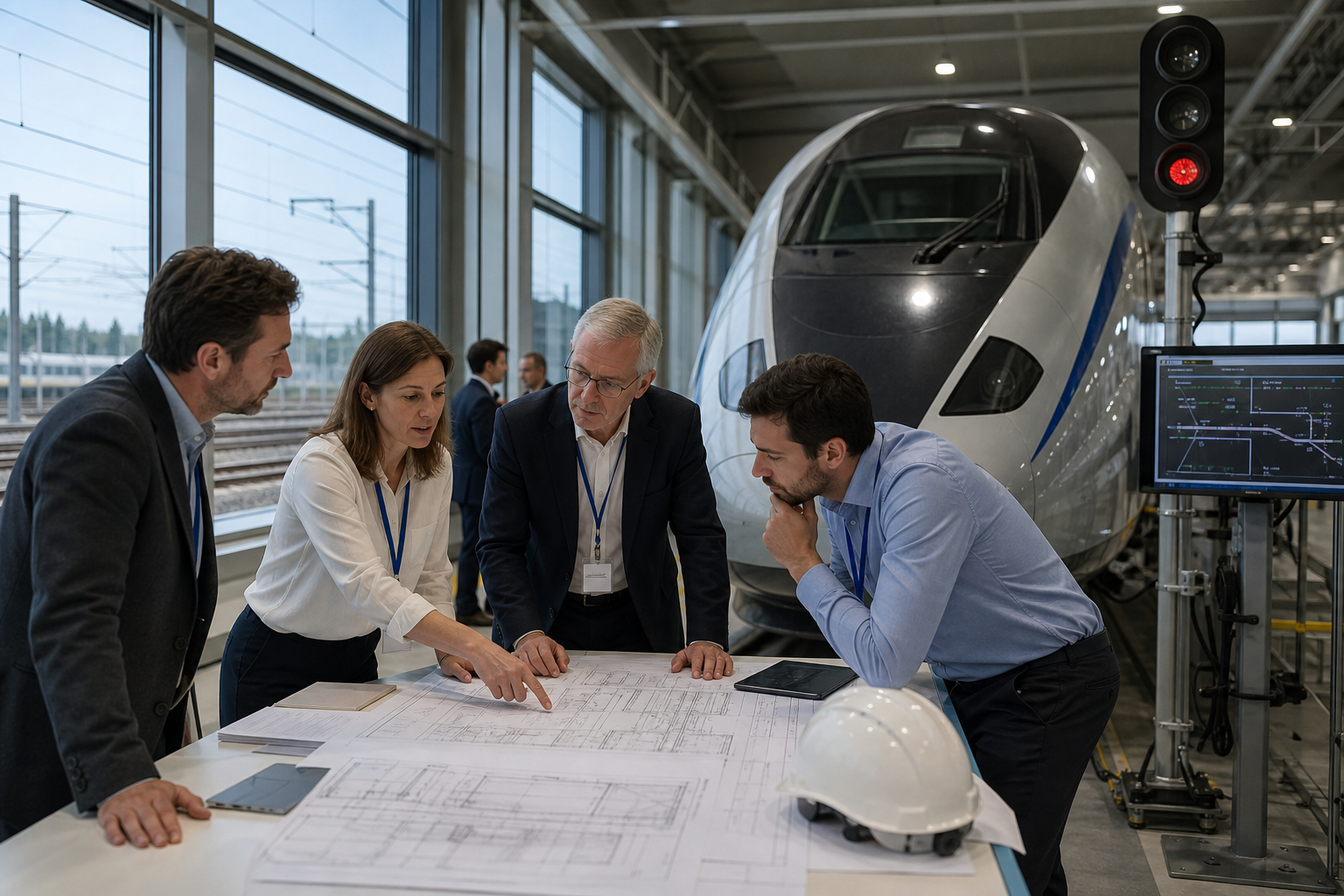
Europe’s high-speed rail expansion is being held back by uncertainty over approvals, technical standards and access to suitable infrastructure, industry leaders have told a conference marking one year since the European Union launched its high-speed rail action plan.
Speaking at InnoTrans 2026, FS International chief executive Luigi Corradi said investment was available, but operators needed confidence that the infrastructure and regulatory conditions would remain stable.
“We can find the money,” Corradi said. “The problem is to make sure that this investment is stable.”
Plan targets 2040 network
The European Commission launched the plan on 5 November 2025, with the aim of creating a faster and more integrated high-speed network by 2040. It includes proposals covering cross-border bottlenecks, track access, rolling stock approvals, ticketing, ERTMS deployment and private investment.
The Commission estimates that completing the planned TEN-T high-speed network alone could require about €345bn in infrastructure investment. Its wider estimate for the overall high-speed rail effort by 2040 is between €354bn and €540bn.
Binding deadlines for resolving cross-border bottlenecks are intended to be set by 2027. Other measures in the plan include a 2026 proposal on cross-border booking, a revised mandate for the European Union Agency for Railways (ERA) to simplify authorisations, and steps to improve access to rolling stock and infrastructure.
Technical barriers remain at borders
Pedro Marco de la Peña, chairman of Spanish infrastructure manager ADIF, said many of the technical issues that had historically restricted cross-border high-speed services could now be addressed.
“All the technological issues, those challenges are over,” he said, arguing that stronger national commitment and mandatory EU supervision were now required. Spain has more than 3,000 route-km of ERTMS in operation, according to ADIF, the largest deployment in Europe.
De la Peña said differences in gauges, electrical systems and regulations had been largely resolved, but infrastructure capacity still fell short in some locations. He described the contrast at the French border as being like arriving “in the Kalahari”, citing limited capacity on conventional lines north of Spain.
Corradi said that even where ERTMS had been installed, national variations could leave international trains carrying several signalling systems. “I have four signalling systems in the train,” he said, referring to differences between France and Italy.
Approval times deter investment
FS International operates high-speed services in France and Spain and plans further expansion into Germany, Austria, Belgium and the UK. Its international passenger business generates about €3bn across six European markets, while its Milano–Paris service has an average load factor of 83%, according to Corradi.
However, he said the Hitachi-built Frecciarossa 1000 had taken 16 years since its first order in 2010 to progress through the approvals needed for operation across Europe. Certification in one country can cost more than €10m, he added.
“Stability is what we need,” Corradi said. “Money is never the problem—there are a lot of people that want to invest in trains.”
For new operators, the uncertainty can be more difficult to absorb. Laurent Fourtune, founder and chief executive of French operator Kevin Speed, said investors could be told that certification and route compatibility might take anywhere from eight months to eight years.
“This is a killer for private investment,” Fourtune said. “There will not be any private investment if there is no reliability, stability in the way we can homologate.”
Alstom European Affairs Director Nicolas Erb said the manufacturer had invested about €150m in additional high-speed production capacity, but that European testing remained “extremely burdensome and time consuming”.
ERA calls for stable specifications
ERA executive director Oana Gherghinescu said the agency would support greater standardisation and scale, more stable technical specifications and closer coordination of ERTMS deployment.
“Freeze them and allow breathing space for all of you here,” she said of the specifications, arguing that investors needed stability. She also called for greater use of standardised platform trains rather than national customisation, saying: “No tailored requirements.”
Magda Kopczyńska, director-general of the Commission’s transport directorate DG Move, said the objective was to create a network operating as an internal market rather than as a collection of national systems.
“It has to be one high speed rail network that works according to the same set of specifications,” she said. “Otherwise we’ll never get the scale that is needed to make that high speed rail work.”