

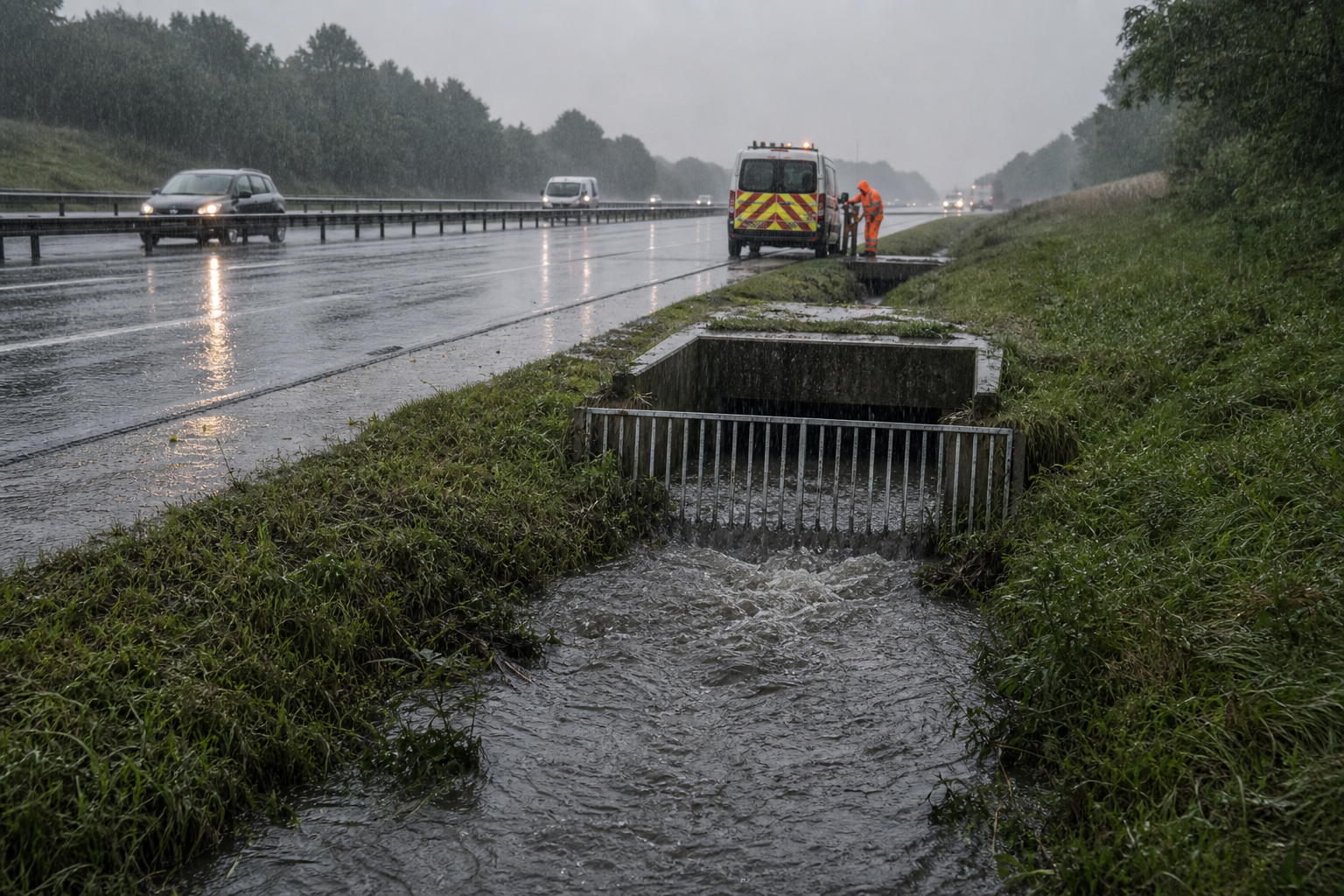
Water quantity should be treated as a central highways resilience issue rather than a secondary design consideration, according to Martin Lambley, director of Somerset-based water management company Hydro International.
Writing for Highways News, Lambley said intense rainfall was placing greater pressure on drainage systems and increasing the risk of disruption on heavily used routes. England’s strategic road network accounts for about 3% of the country’s roads, but carries a third of motorised traffic and two-thirds of freight, he said.
Analysis by the Financial Times of Ordnance Survey, Fathom and Environment Agency data has indicated that almost a third of main roads into Greater London, 40% of those into Birmingham and more than half of those into Greater Manchester are at risk of disruption from river flooding.
Drainage and RIS3
The issue forms part of the wider resilience challenge facing National Highways’ Road Investment Strategy 3. The £27bn, five-year programme covers planned investment in England’s motorways and major A-roads, including maintenance and renewal work intended to improve network performance and reliability.
National Highways’ 2030 Water Quality Plan sets out a programme to inspect, prioritise and upgrade high-risk drainage assets. Although the plan focuses on pollution, Lambley said drainage performance also needed to be assessed by how effectively systems move water away from carriageways, provide storage and reduce disruption during periods of peak rainfall.
He said scheme designs should consider catchment behaviour, runoff volumes, available land, maintenance requirements and the operational risk created when water remains on or close to a road.
Combining natural and engineered systems
Nature-based drainage can slow flows, provide storage and reduce pressure on downstream assets. However, Lambley said such measures may not be sufficient where land is constrained, ground conditions are difficult or large volumes of water must be controlled within a limited footprint.
Combining natural drainage with engineered attenuation and flow-control systems can provide an alternative on constrained sites, including junctions, cuttings and urban approaches.
The A428 Black Cat to Caxton Gibbet improvement scheme is cited as an example. Its drainage design is due to include 58 Hydro-Brake Optimum vortex flow controls, which Hydro International says can reduce the storage required upstream by allowing higher flows at lower hydraulic heads.
The scheme will also use flow-control and sediment-removal technologies across different site configurations. Hydro International says the adjustable inlets on most of its Hydro-Brake Optimum units can allow discharge rates to be changed if future development or climate pressures alter hydraulic requirements.
Lambley said drainage strategies based on the volume and movement of water could help highways authorities reduce flood risk, limit disruption and improve the reliability of critical routes.