

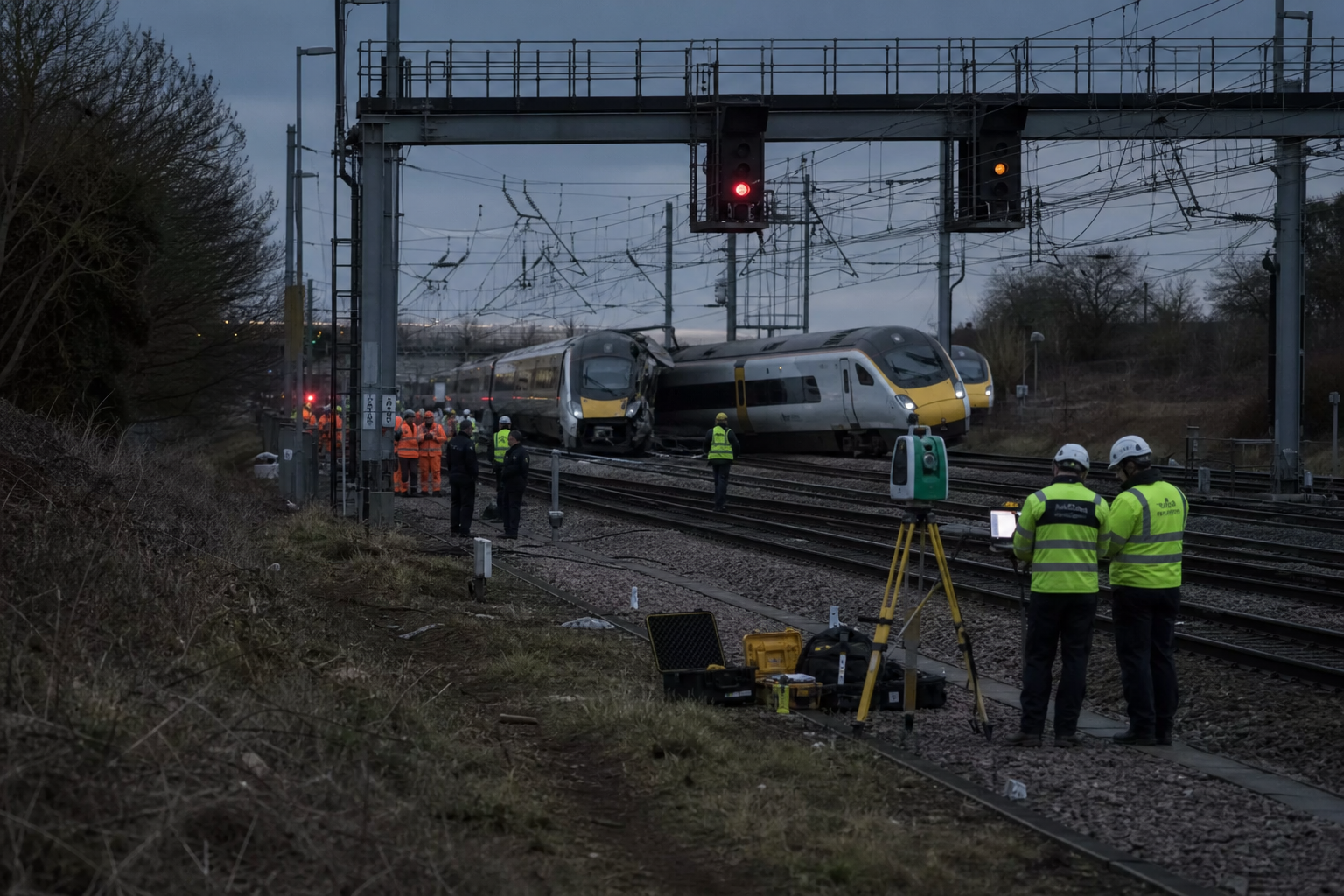
A passenger train involved in a fatal collision near Bedford accelerated after its automatic warning system (AWS) issued a warning for a red signal, according to an interim report by the Rail Accident Investigation Branch (RAIB).
The crash happened at about 5.15pm on 19 June on Network Rail’s Midland Main Line, around 4km south of Bedford station. East Midlands Railway service 1H46, travelling from Corby to London St Pancras, passed signal WH154 before colliding with service 1B67 from Nottingham to London St Pancras.
The driver of 1H46, 60-year-old Shaun Burton, died in the accident. A further 162 people were injured, with 102 requiring hospital treatment.
Train reached 122km/h
RAIB said the driver of 1H46 acknowledged an AWS warning as the train approached WH154, which was displaying red. Downloaded data showed the train continued to accelerate, reaching about 122km/h, before full-service braking was applied roughly 10 seconds before impact. Emergency braking followed around two seconds later, with the train travelling at about 80km/h when it collided.
The five-car Class 810 service 1B67 had stopped beneath a signal gantry after its AWS generated a warning while WH154 was displaying green. Its driver did not acknowledge the warning within the required 2.7 seconds, triggering the train’s automatic emergency brake. The driver then contacted the signaller to report an AWS fault.
Investigation continues into signalling equipment
Both trains derailed in the collision. The leading cab of 1H46 and the rear cab of 1B67 became embedded together, shortening the combined trainset by between 9m and 10m.
WH154 is an automatic four-aspect signal controlled from West Hampstead. It was not fitted with Train Protection and Warning System (TPWS) train-stop loops because plain-line automatic signals at that location were not required to have them under existing regulations and risk assessments. Network Rail’s latest assessment placed the signal in a low SPAD risk category.
RAIB said testing after a separate similar incident on 9 July found the AWS electromagnet at WH154 was 16mm below railhead level, outside its specified tolerance and lower than the associated permanent magnet. There was no evidence that the electromagnet was not energised, and the branch is continuing to examine how the track equipment interacted with the trains’ AWS systems.
The interim report also identified differences between the TPWS controls on the two train types. The Class 810 had an enhanced TPWS panel with different layout and alarm behaviour, while witness evidence indicated that the audible AWS/TPWS alarm in the cab of 1B67 was not recognised and its AWS acknowledgement button was not pressed.
RAIB’s investigation remains ongoing. It is examining why 1H46 passed WH154 at danger, the performance of braking and safety systems, the reason 1B67 stopped, the crashworthiness of both trains, the emergency response and Network Rail’s process for assessing SPAD risk at the location.