

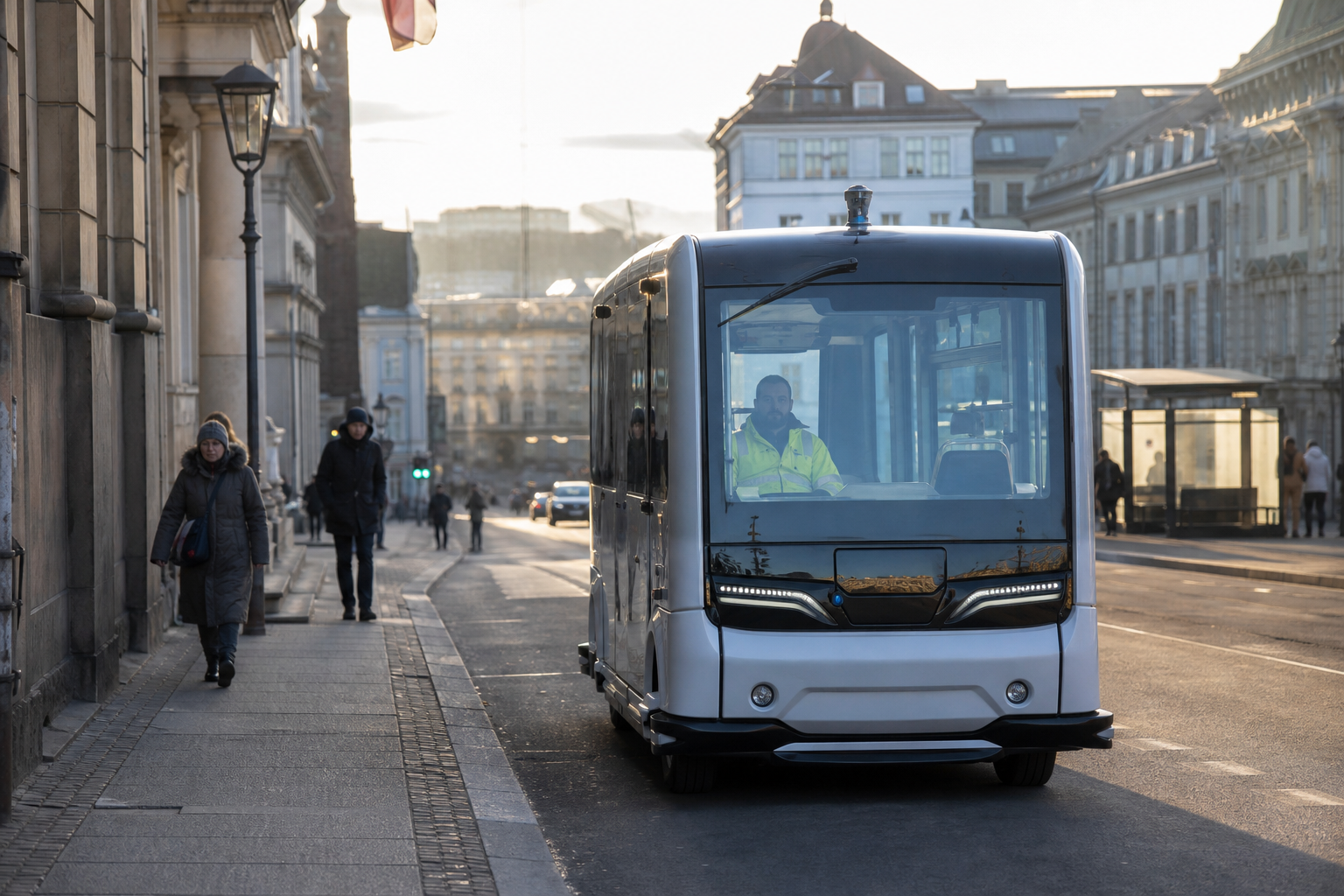
Autonomous buses are moving from controlled demonstrations towards public-service trials, but the technology’s commercial case and regulatory pathway remain unresolved.
Most projects still use an onboard safety driver, while operators and manufacturers are also testing driverless functions in depots, where vehicles can move between parking, charging, washing and maintenance areas on private land.
Germany targets Level 4 deployment
Germany is emerging as one of Europe’s main markets for higher levels of bus automation. The public transport association VDV welcomed the Federal Ministry of Transport’s strategy paper in late 2024 and called for an investment programme supporting Level 4 vehicles.
VDV expects the first combinations of vehicle and Level 4 autonomous-driving systems to reach market maturity in Germany by 2027. Its president, Ingo Wortmann, said: “Then we need to guarantee four-digit purchase quantities by means of targeted funding from the new federal government as public transport for the industry so that the vehicles can also be produced in large numbers in Germany with the associated effects.”
MAN’s MINGA project in Munich illustrates the staged approach. The manufacturer is working with Mobileye and has also turned to Adastec for the automated-driving system. A 12-metre Lion’s City E is scheduled to complete public-road validation without passengers before a passenger-carrying pilot by Münchner Verkehrsgesellschaft, planned for autumn 2026.
MAN has said it is targeting full series production of autonomous buses by the end of the decade. Separately, its BeIntelli project began operating in Berlin in spring 2024, using an automated electric bus on a digitalised test track to demonstrate the technology and explain its operation to passengers.
Karsan leads European bus deployments
Turkish manufacturer Karsan has become one of the most active suppliers of autonomous buses in Europe. Its Autonomous e-Atak, fitted with Adastec’s flowride.ai Level 4 platform, entered passenger service in Stavanger in 2022. The bus is operated by Vy Buss and has been tested on routes involving lane changes, heavier traffic, higher speeds and a tunnel.
Further projects are under way in Tampere, Finland, and Gothenburg, Sweden. The Gothenburg service, financed by the Västra Götaland region and operated within the Västtrafik network, is planned to connect Gothenburg Central Station with Liseberg station from August 2025. A safety driver will remain onboard, with software supplied by Norwegian company Applied Autonomy.
The vehicle uses LiDAR and radar systems to detect its surroundings. Adastec chief executive Ali Ufuk Peker said in 2023 that the company believed bus automation offered a clearer return on investment than some other applications, because operators face high costs. He said the company expected to break even at around 200 buses.
Hamburg plans large-scale shuttle programme
Hamburg’s ALIKE project is intended to demonstrate autonomous on-demand transport at a much larger scale. An agreement between the Federal Ministry of Transport and the city provides for the possibility of up to 10,000 autonomous shuttles operating by 2030.
The Holon Mover and Volkswagen ID.Buzz AD are expected to be among the first vehicles tested. Holon, backed by Benteler, is developing a purpose-built autonomous shuttle rather than adapting a conventional bus. Benteler strengthened its position in the sector in early 2026 by acquiring ioki, which specialises in on-demand and autonomous mobility services.
Holon has also announced plans to manufacture its urban autonomous vehicle in Jacksonville, Florida, for future public transport, campus and other controlled-environment applications.
Safety drivers and workforce concerns
Norwegian authorities approved autonomous bus operations without an onboard safety driver in 2025, under defined conditions. The decision marked a move beyond the safety-driver model used by most earlier pilots, although it does not represent unrestricted driverless operation.
Workforce concerns are also shaping deployment. In the United States, the Transport Workers Union reached an agreement with the Central Ohio Transit Authority in 2024 that gives the union veto power over the introduction of autonomous-driving technology.
The UK’s CAVForth project, involving Stagecoach, Transport Scotland, Alexander Dennis and Fusion Processing, operated five automated Enviro200 buses between Fife and Edinburgh. Supported by £4.35m of government funding, the service carried passengers across the Forth Road Bridge with safety drivers onboard. It ended on 14 February 2025 after passenger numbers fell below target.
Depots offer an earlier commercial opportunity
Depot automation may arrive before fully driverless passenger services because it can operate in a controlled environment and does not require the same public-road approval. Demonstrations by Volvo Buses and Iveco have shown electric buses moving autonomously between parking, washing, maintenance and charging areas.
Polish company Autonomous Systems has developed SmartDEPOT, which can be fitted to a standard city bus. The system is designed for low-speed movements on enclosed premises and is coordinated through a control system operated by a designated Smartbus Coordinator.
An assessment by MZA Warsaw estimated that depot manoeuvring takes around 35 minutes of driver time per vehicle each day, with a potential value of about €88,000 per vehicle over a 12-year lifecycle. Such savings could provide a more immediate business case than removing drivers from passenger routes.
The market remains unsettled. ZF announced in 2024 that it would stop producing autonomous shuttles and instead concentrate on autonomous-driving technology and engineering services. Navya filed for cessation of payments with the Commercial Court of Lyon on 25 January 2025, after years of falling share value and financial pressure.
These developments suggest that autonomous buses are progressing technically, but the transition to widespread driverless public transport will depend on more than vehicle capability. Operators still need reliable regulation, public confidence, workable labour arrangements and enough savings to justify the investment.