

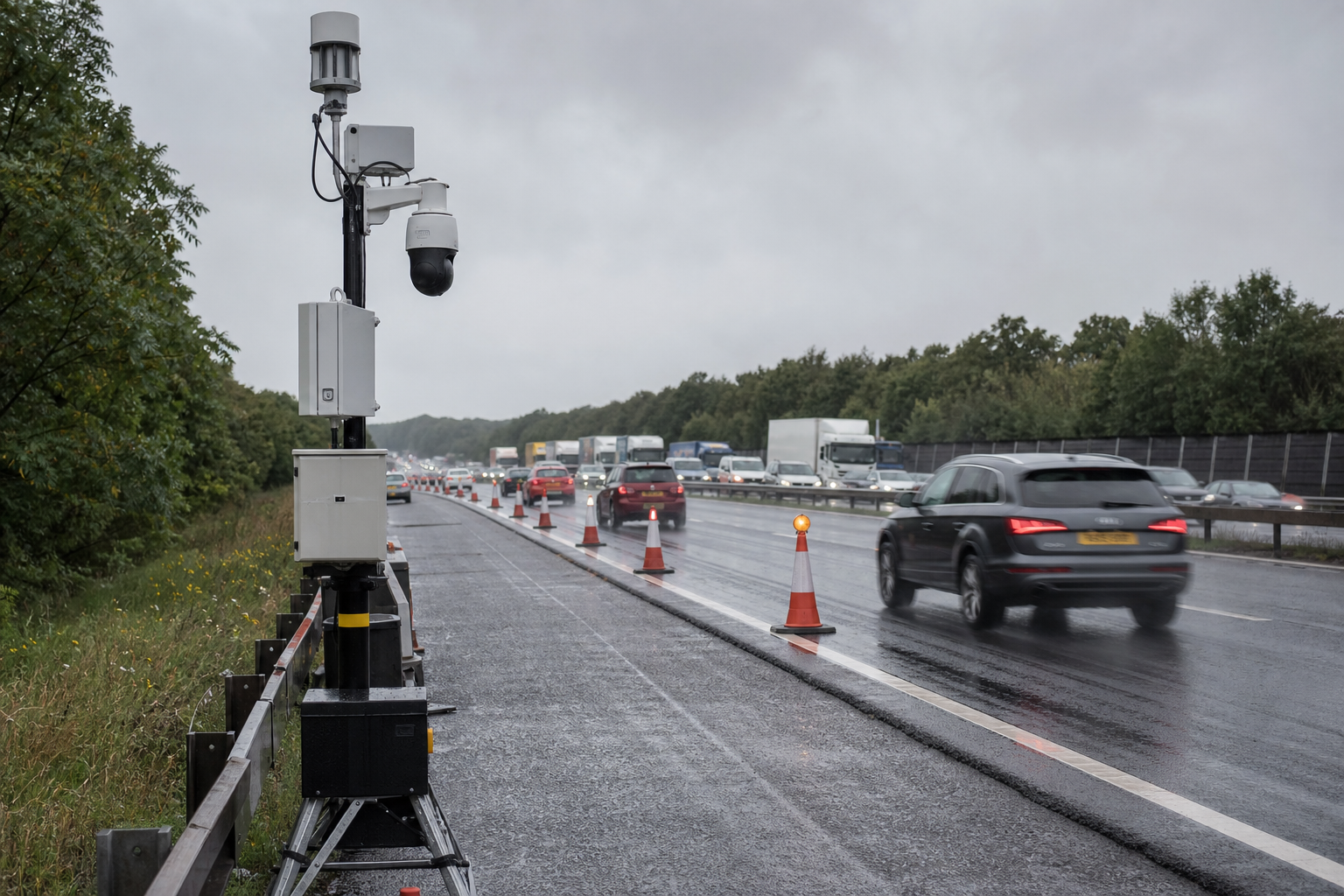
Roadside Technologies has released VECTA, an automated roadside monitoring platform designed to detect hazardous objects and provide traffic analytics, following an 11-month trial on a live UK motorway.
Four VECTA towers were deployed along approximately 1km of motorway alongside a remote CCTV monitoring service. The comparison used genuine operational events rather than simulated scenarios, allowing the company to assess how automated detection could work with existing monitoring and response processes.
Automated alerts and vehicle analysis
Roadside Technologies said VECTA detected, classified and alerted operators to roadworks hazards within the same second. For 98% of comparative incidents, it raised alerts 98% faster than standard monitoring services.
Analysis of CCTV recordings covering 1,500 vehicles recorded 100% daytime vehicle-classification accuracy, 98% accuracy at night and 97% vehicle-counting accuracy. The company said performance remained high in low light, rain and poor weather.
During the trial, the roadworks monitoring database collected more than 473 million messages between the four towers. The data included 166,000 vehicle detections, approximately 864,047 MQTT messages per tower per day and more than 3.5 million unique object IDs in a single month.
Roadside Technologies used the data to assess coverage, object classification, work-zone incursions, wrong-way driving, queue formation and automated alerting in a live roadworks environment.
LiDAR and edge AI
VECTA combines LiDAR, edge artificial intelligence perception software and a fusion engine to maintain a continuously updated digital representation of the road. Its alert types include stopped vehicles, congestion and queues, work-zone entry, cone-line incursions, wrong-way driving, pedestrians and other hazardous objects.
When an alert is generated, the system’s pan-tilt-zoom camera turns towards the incident so an operator can verify the event and decide the response. Roadside Technologies describes VECTA as a supplement to CCTV rather than a replacement, retaining human judgement in the operating process.
Chris Moseley, managing director of Roadside Technologies, said the trial demonstrated that automated detection could give operators earlier awareness of developing hazards while complementing existing CCTV and operational procedures.
Gary Bray, the company’s commercial director, said VECTA brought automated alerts, live CCTV, reporting and traffic analytics together in one platform, allowing customers to respond more quickly to events across a work zone.
The system originated through the National Highways Hazard Protection on Roads Accelerator, delivered by Connected Places Catapult. Roadside Technologies said the technology is the subject of a pending patent application.
The company is developing further enhancements and plans to demonstrate VECTA Cloud at Highways UK 2026 at the NEC Birmingham on 14 and 15 October. It will also preview an integration with variable message signs.