

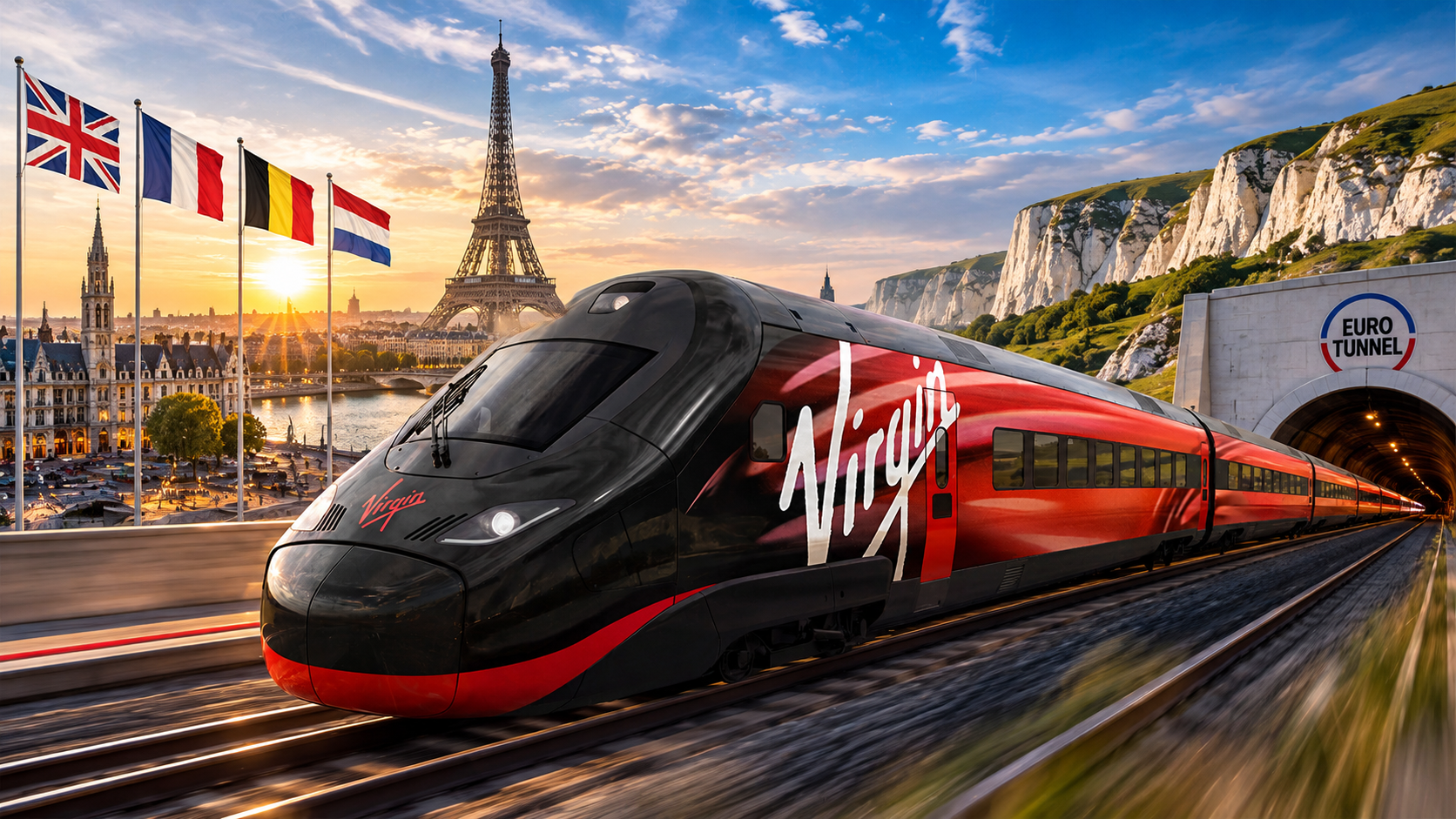
For more than 30 years, Eurostar has enjoyed something virtually unheard of in European transport: an uninterrupted position as the sole passenger rail operator connecting Britain with mainland Europe through the Channel Tunnel.
That could change in 2030.
Virgin Trains has confirmed ambitious plans to operate 20 daily return services connecting London with Paris, Brussels and Amsterdam, potentially introducing almost 7.5 million additional seats annually.
The company has agreed to acquire 12 high-speed trains from Alstom and secured maintenance arrangements at Temple Mills International depot in east London.
Crucially, the Office of Rail and Road (ORR) has approved the framework for Virgin to access High Speed 1 from October 2030 until December 2040.
There are still regulatory and operational hurdles, but this is now considerably more than an ambitious proposal.
Is Eurostar’s monopoly finally coming to an end?
For passengers, competition could be the most significant development since international services began operating through the Channel Tunnel in 1994.
Eurostar has established itself as a premium alternative to flying, particularly between London and Paris, where city-centre connections offer considerable advantages over airport travel.
However, passengers have frequently questioned ticket prices, particularly when booking at short notice.
Without direct competition, Eurostar has faced limited pressure from rival rail operators to reduce fares or introduce alternative service offerings.
Virgin’s arrival could change that.
Two operators competing for passengers would potentially introduce more competitive pricing, promotional fares, improved loyalty programmes and greater flexibility.
But cheaper tickets are not guaranteed. Both operators will face substantial infrastructure charges, operating costs and the expense of purchasing specialist rolling stock.
Nevertheless, competition should give passengers something they have never previously enjoyed on cross-Channel rail: genuine choice.
Could other operators follow?
Virgin may simply be the beginning.
Italian operator Trenitalia has already expressed ambitions to enter the market, while Evolyn and Gemini Trains have also developed proposals.
Trenitalia has subsequently pursued plans involving new high-speed trains and alternative maintenance arrangements.
The principal obstacle remains infrastructure.
Temple Mills is currently the only British depot equipped to accommodate Channel Tunnel passenger trains, and its limited capacity has historically presented a significant barrier to new entrants.
Although Virgin secured access, the ORR previously concluded that existing depot capacity could not accommodate every proposed operator alongside Eurostar’s expansion ambitions.
That raises an interesting possibility.
Could competition stimulate investment in additional maintenance facilities, international terminals and supporting infrastructure?
If operators can demonstrate sufficient demand, entirely new facilities could become commercially viable.
What about Ashford and Ebbsfleet?
Perhaps the most interesting opportunity lies beyond London.
Before the pandemic, Eurostar served Ashford International and Ebbsfleet International in Kent.
Neither station has received international Eurostar services since 2020.
Their absence has left passengers across Kent and parts of southeast England travelling into London before heading back towards the Channel Tunnel.
That seems increasingly difficult to justify if cross-Channel services are entering a period of substantial expansion.
Virgin has indicated an interest in exploring services serving Kent, although no commitments have been made.
Reopening international services would require investment in border-control facilities, security arrangements and station infrastructure.
Nevertheless, restoring international connections could deliver economic benefits to surrounding communities, businesses and regional tourism.
There is also the possibility of Stratford International finally fulfilling its original promise as an international gateway.
Despite its name, Stratford has never hosted scheduled international passenger services.
Could a competitive market finally change that?
Could we see entirely new European destinations?
This is where the opportunities become particularly interesting.
Virgin’s initial focus is Paris, Brussels and Amsterdam, but its longer-term ambitions extend towards Germany and Switzerland.
Eurostar itself has been exploring expansion towards destinations including Frankfurt, Geneva and Cologne.
Imagine boarding a train in London and travelling directly to Frankfurt, Geneva or other major European cities without changing services.
For business travellers, tourists and those increasingly conscious of aviation emissions, that could prove attractive.
However, international rail expansion is complicated.
Operators must negotiate access to multiple national rail networks, obtain safety approvals and accommodate different signalling systems.
There are also immigration and security arrangements to consider, particularly for destinations without existing UK border-control facilities.
The potential is considerable, but delivering it requires much more than purchasing additional trains.
Could airlines become the biggest losers?
One of the most interesting consequences may be felt in aviation.
Rail already competes effectively with airlines on London–Paris and London–Brussels journeys.
Additional capacity, greater frequency and competitive pricing could encourage more passengers to abandon short-haul flights.
Virgin also has an advantage through its wider travel business.
The company is exploring opportunities to connect its international rail services with Virgin Atlantic flights, potentially allowing passengers arriving at London airports to continue their journeys across Europe by train.
Integrated ticketing and loyalty benefits could make those connections increasingly attractive.
The challenge will be making rail genuinely competitive on convenience, journey time and price rather than relying solely on its environmental credentials.
What does this mean for Eurostar?
Eurostar is unlikely to surrender market share without responding.
The operator is already investing in new rolling stock and pursuing ambitious passenger growth targets.
Competition could accelerate improvements in onboard facilities, digital booking, customer service and pricing.
It may also encourage Eurostar to reconsider its route network and previously suspended stations.
However, there is a wider question about whether Britain’s international rail infrastructure can accommodate the ambitions of multiple operators.
St Pancras International faces capacity constraints, while border processing and platform availability could become increasingly significant as passenger numbers grow.
Unless those issues are addressed, infrastructure rather than customer demand could ultimately determine how much competition develops.
The real opportunity is bigger than Virgin versus Eurostar
Virgin’s plans represent more than another company entering an established market.
They raise fundamental questions about how Britain approaches international rail connectivity.
Could new operators stimulate investment in stations that have remained underused for years?
Could additional routes connect more European cities directly with London?
Could improved competition make rail a realistic alternative to flying for millions more passengers?
And could regional international stations finally become an important part of Britain’s wider transport network?
The answers will depend on investment, infrastructure capacity and regulatory cooperation.
But one thing is becoming increasingly clear.
The most important outcome of Virgin’s arrival may not be who wins the battle for passengers between London and Paris.
It could be whether competition finally unlocks the full potential of the Channel Tunnel, more than 30 years after it opened.