

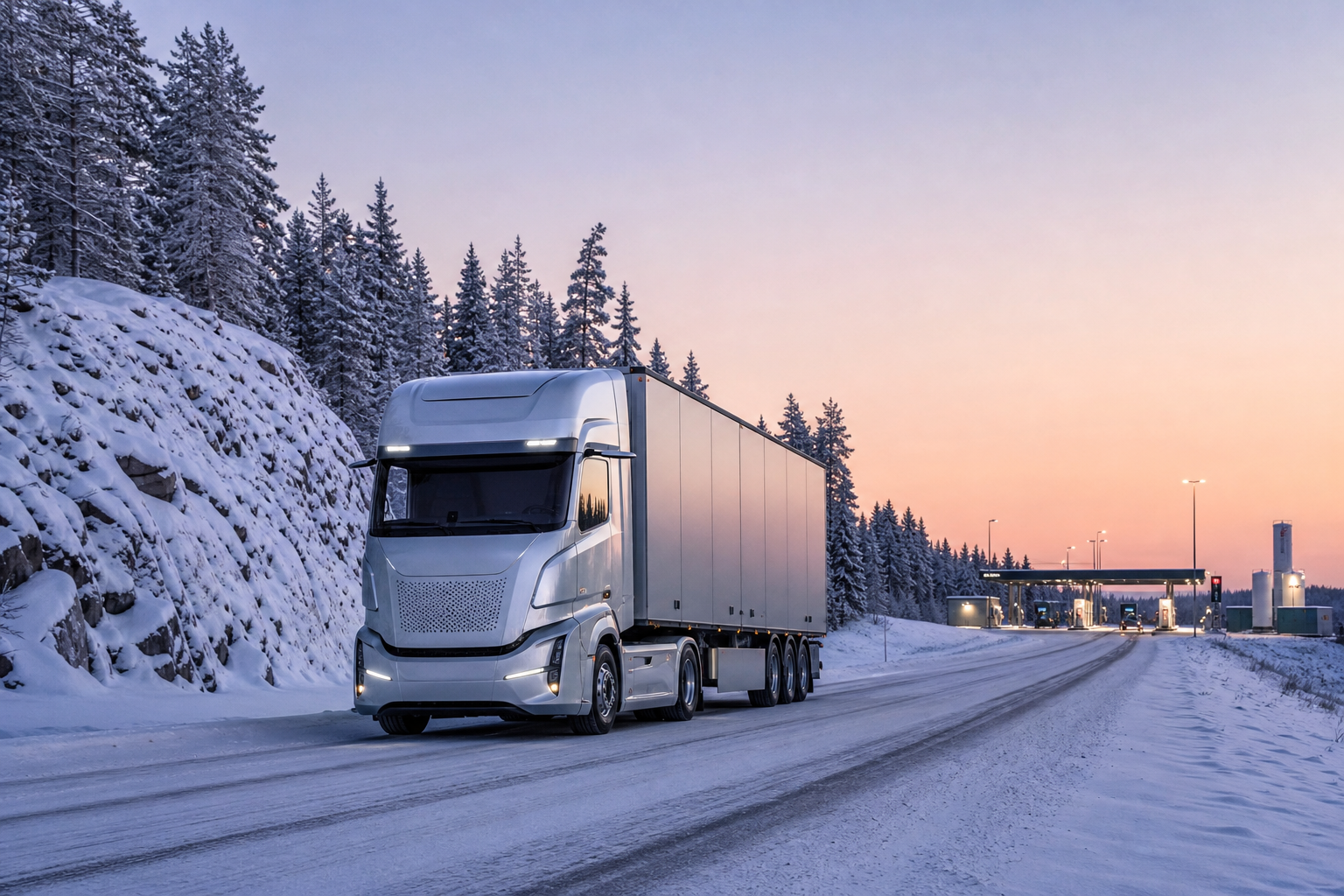
A pilot project in Finland will test whether hydrogen and electricity can work together to power heavy-duty transport on long-haul journeys.
Led by VTT Technical Research Centre of Finland, the project will put the SISU Escalate truck into normal transport operation in late 2026. The vehicle is designed to run mainly on electricity, with a hydrogen fuel cell providing an alternative power source for rapid charging during long-haul assignments.
The truck has a 650kWh battery and a fuel cell with maximum power of 120kW. It will be operated by Jylhä Logistics on a route between Vuosaari harbour in southern Finland and Jyväskylä in central Finland, covering 540 kilometres a day.
Data-led trial
The journey will be monitored continuously using vehicle data and a digital twin. Charging stations are located at both ends of the route, while a megawatt-scale charging station is due to be built along it. Jyväskylä also has a hydrogen fuel station.
The project team will use energy prices and operational data to assess how much electricity and hydrogen should be carried and where energy should be supplied. Results will be benchmarked against diesel-powered vehicles to examine potential cost benefits.
VTT research professor Mikko Pihlatie said the six-month monitoring period would show how performance and energy consumption were affected by factors including weather, while identifying operational limitations and informing the development of a charging network.
“A total of four trucks are piloted across Europe in this project, with different structures and power sources,” he said. “SISU Escalate is the heaviest and longest of these. With its size and the difficult winter conditions in Finland, the operating environment of this truck is the most demanding of the four.”
Technology development
The vehicle has been manufactured by Sisu Auto, with IONCOR supplying the battery system. Kempower is providing the megawatt charging infrastructure, while Hevtec is responsible for the vehicle-side charging solution and integration of the electric powertrain.
A full-electric version of the truck was tested by logistics company Rauanheimo in spring 2026.
Petri Kananen, head of development at Sisu Auto, said the SISU Escalate was a technology demonstrator rather than a vehicle intended for market launch.
“With the learnings from the pilot, we can choose the best solutions for a product series developed for the market,” he said. “The data will help us develop energy management systems and optimise driving with the battery to maximise the distance that can be driven with electricity. Hydrogen is, after all, the more expensive fuel.”
IONCOR senior manager of technology development Juuso Kelkka said the trial would test a modular lithium-ion battery platform in a 76-tonne articulated vehicle operating in harsh winter conditions on a long-haul route.
“With this truck, we can prove that a lithium-ion battery is a viable solution even in these conditions,” he said.
The pilot is part of the EU-funded ESCALATE project, which aims to demonstrate that a zero-emission heavy vehicle can operate reliably in real-world driving conditions.