

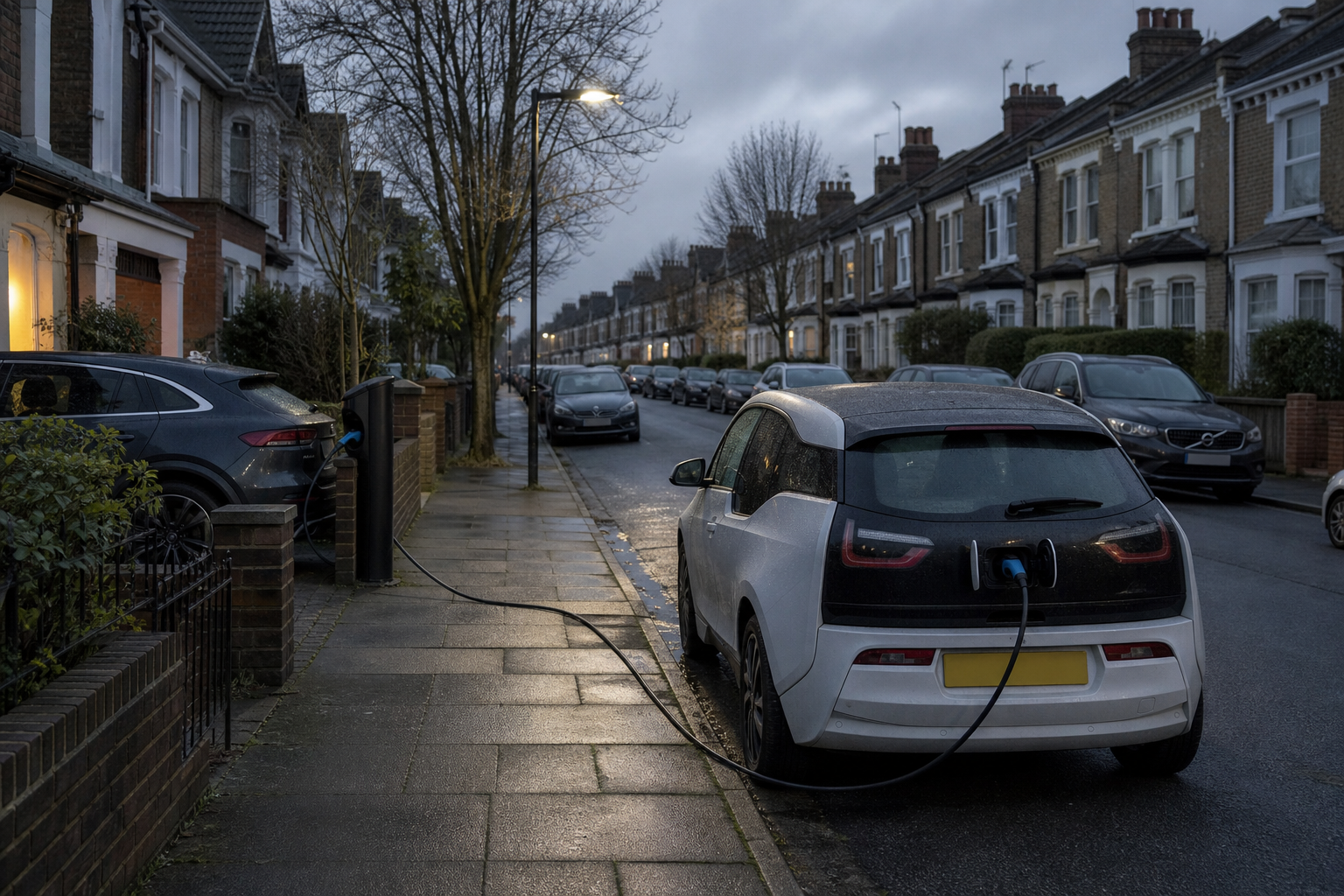
Electric vehicle drivers without access to home charging are seeing far fewer financial benefits than those with off-street parking, according to EVA England’s largest survey to date.
Fewer than a third of respondents unable to charge at home said they had achieved substantially lower running costs. That compares with 84% of drivers with off-street domestic charging. Across the full sample, 94% reported lower running costs than they would have faced with a petrol or diesel vehicle.
The Steer the Conversation survey received 2,635 responses. EVA England said its findings showed that reliance on public chargepoints had “wiped out” the financial advantage of buying an EV for some households, creating a risk that the disparity will deter future adopters.
Public charging confidence falls
Only 48% of respondents said the public charging network had improved, down from 69% in the previous year’s survey. Meanwhile, 42% said public charging costs had risen over the past 12 months.
Among those who had experienced a charging problem, 44% either did not know how to report it, could not contact the operator or received no response. The survey also found that 38% believed UK Government announcements and policy changes had reduced their confidence in EV ownership.
Home charging remains central to the ownership experience: 88% of EV drivers surveyed said they charged using their own electricity supply. However, upfront purchase costs remain a barrier, with 52% paying more for their electric car than they would have paid for a comparable petrol or diesel model. Among petrol and diesel drivers, 41% identified purchase cost as a key obstacle to switching.
Only 5% of EV drivers said recent Government announcements and policy changes had increased their confidence in ownership. At the same time, 71% said the public debate about EVs did not accurately reflect their own experience.
Call for lower costs and clearer policy
EVA England is calling for a consistent long-term direction for the transition, alongside action to reduce the cost and practical difficulty of switching. Its priorities include lower-cost leasing for households on modest incomes, cheaper public charging and stronger independent oversight of chargepoint standards and complaints.
Dr Vicky Edmonds, CEO of EVA England, said: “Electric cars work. The people driving them are saving money, they love their cars, and most wouldn’t dream of going back. But there’s a huge catch: right now, the biggest savings are still overwhelmingly going to people who have a driveway and can charge cheaply at home.”
She added: “At precisely the moment we need to be giving people confidence to make the switch, the constant political back-and-forth over EV targets and new taxes is creating more uncertainty. We should be building on the success we’ve achieved, not giving people reasons to hesitate.”
Mark McCall, chair of EVA Northern Ireland, said the survey showed EV drivers “overwhelmingly love their vehicles” and called for a consistent, long-term approach from government.
Neil Swanson, director of EVA Scotland, said home charging remained “the greatest enabler” and that more needed to be done to ensure a just transition. Paul Bevan, chair of EVA Cymru, said confidence among drivers was still being affected by decisions made at Westminster, despite the infrastructure gap in Wales narrowing.