

Northern Ireland’s Department for Infrastructure (DfI) has published its Transport Strategy 2035 and opened consultation on the first regional plan to shape investment across the east of the region.
The draft Eastern Transport Plan 2035 sets out proposals for Belfast and the wider metropolitan area, with a focus on reducing carbon emissions, improving connectivity and making travel “cleaner, smarter and more inclusive”.
It is the first of 11 regional plans expected to inform transport priorities through to 2035. The plan has been developed with Antrim and Newtownabbey, Ards and North Down, Belfast, Lisburn and Castlereagh, and Mid and East Antrim councils.
Bus, cycling and pedestrian proposals
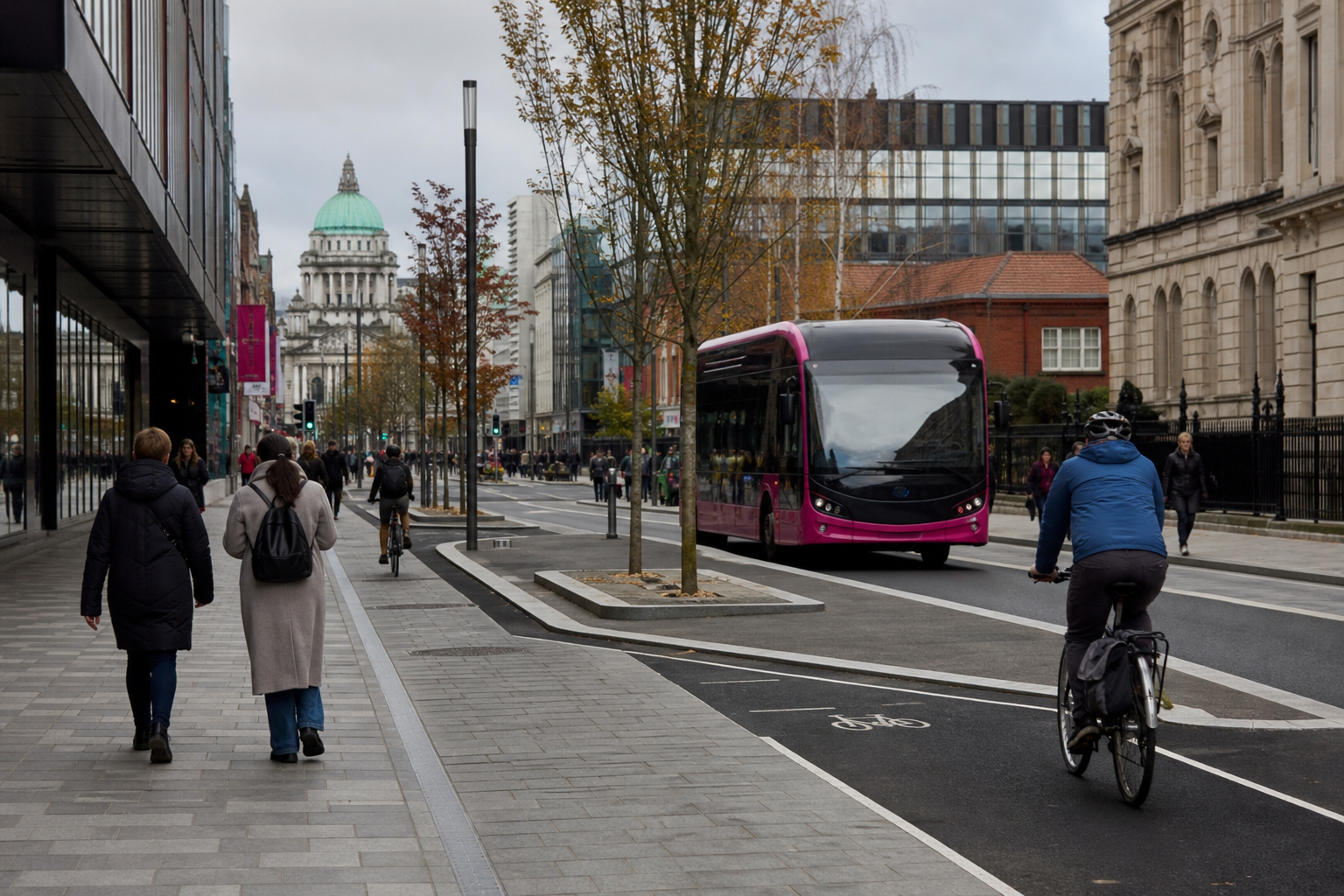
Proposals for Belfast city centre include more pedestrian-priority streets, a new civic spine and a city-wide 20mph speed limit. The draft also proposes new Glider routes, simpler bus routing, additional bus-priority measures and an expanded segregated cycling network.
The plan includes measures to reduce through-traffic and changes to parking management. Across the wider metropolitan area, the DfI is proposing new Glider corridors on key radial routes, further bus-priority improvements, upgraded cycling infrastructure, targeted 20mph zones and public-realm improvements in local centres.
New and expanded Park & Ride facilities are also included in the draft.
The department said the measures are intended to increase travel choice, improve access to services and employment, support better air quality and public health, and make streets safer and more accessible.
The initial consultation is concentrated on Belfast and the wider metropolitan area because Belfast City Council’s Local Policies Plan is at a more advanced stage. The DfI has not yet published a timetable for consultation on the remaining 10 council areas.
Minister calls for public feedback
Northern Ireland infrastructure minister Liz Kimmins said the strategy sets out a vision for “a more sustainable, safe, accessible, inclusive and effective transport network” serving urban and rural communities.
“This first phase of the ETP marks the beginning of an important journey towards delivering that vision,” she said. “Public feedback will play a vital role in shaping its future.”
The DfI said engagement undertaken when the draft Transport Strategy was consulted on in June 2025 showed clear support for its sustainability and resilience objectives.
Existing and planned Belfast schemes
The strategy is being developed alongside major transport projects in Belfast. AtkinsRéalis has been appointed to take Belfast Rapid Transit Phase 2 from detailed design towards construction under a commission running from 2026 to 2032. The project is intended to extend the Glider network north and south beyond the routes served by the first phase, which opened in 2018.
Belfast Grand Central Station, an approximately £340m public transport investment, began handling passengers in September 2024. The facility combines rail and bus services, with eight railway platforms and 26 bus stands. Passenger capacity is expected to increase from around 10 million to more than 20 million journeys a year.
Other planned schemes include the proposed Sailortown pedestrian and cycle bridge across the River Lagan and a separate potential crossing between the Gasworks site and the Ormeau Embankment. The latter is reported to be approximately 143m long, with an estimated cost of up to £28m, but remains a planned scheme rather than a confirmed development.
Consultation responses will help shape the final Eastern Transport Plan 2035.