

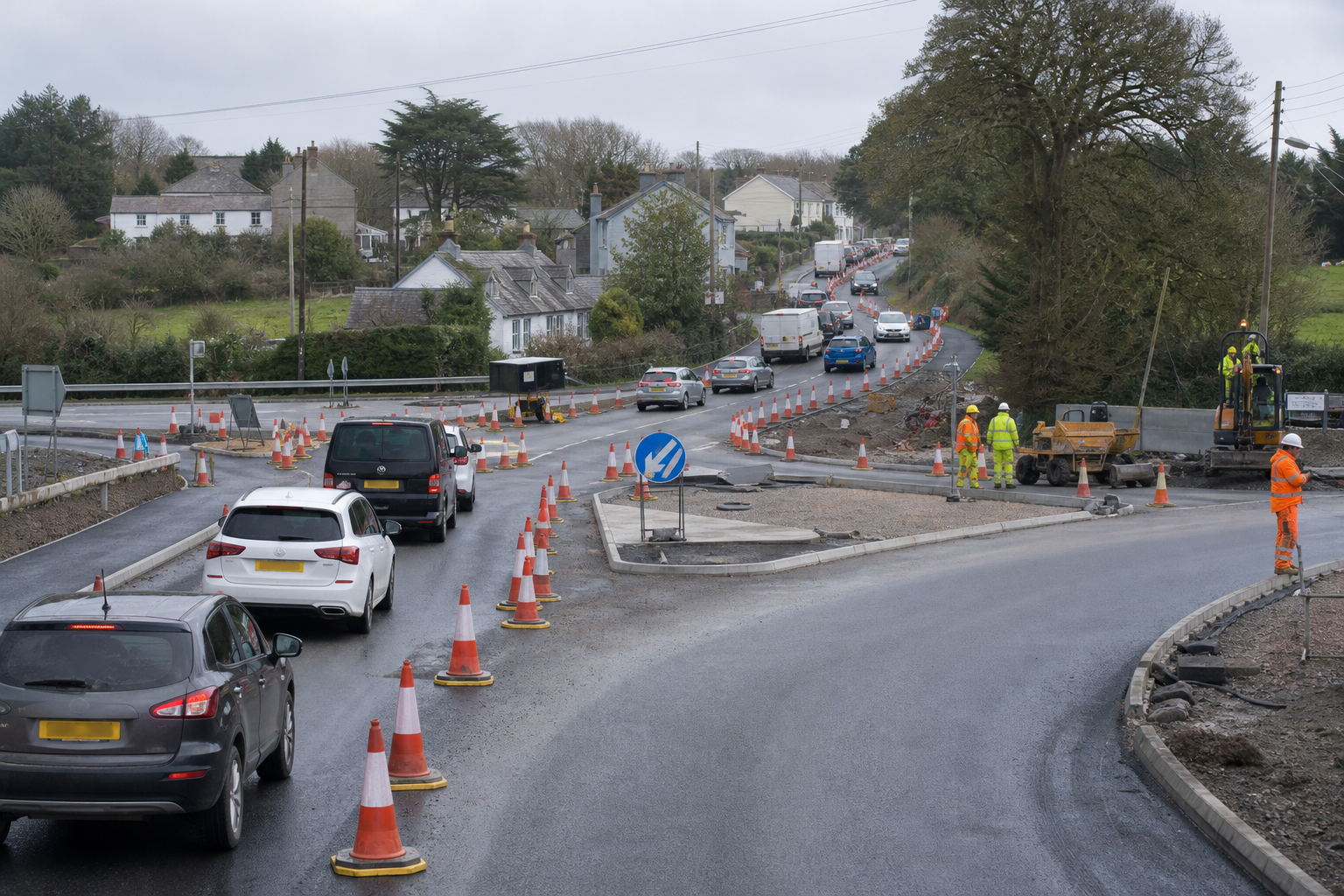
National Highways has begun a £9.8m safety scheme on Cornwall’s A30, with local councillors warning that the way the work is being delivered is creating severe congestion in nearby villages.
The project, which started on 5 September, covers the stretch between Kennards House and Five Lanes and includes improvements at six junctions, including Plusha. Drivers are being warned to expect delays and diversions while a single lane remains open in both directions.
Safety case is not in dispute
The scheme follows a coroner’s inquest into collisions at Plusha junction. Between 2015 and 2024, 22 crashes there resulted in three deaths, nine serious injuries and 54 casualties, according to the source material.
Peter Pridham, who has worked at the Plusha services for 13 years, said he had seen local customers affected by collisions. He supports the planned widening and clearer exit arrangements, which he believes will help traffic slow down safely, although he also experiences the roadworks delays during his daily commute.
The work is being delivered as one continuous construction area between Kennards House and Five Lanes, rather than in separate phases at each junction. Ian Ellis, National Highways’ programme delivery manager, said the approach would allow several activities to take place at the same time, shortening the overall programme and avoiding further closures to change traffic management later.
National Highways is working six days a week and scheduled the main programme outside the busiest summer and holiday period. The works are expected to continue for about six months.
Traffic diverted through villages
Adam Paynter, the independent councillor for Launceston North and North Petherwin, said he had warned National Highways about the impact of closing one lane in each direction along with the official diversion.
He argued that closing only the sections being actively worked on could reduce the disruption. “If there was a smaller amount of road closure on the A30 that would make a big difference,” he said.
Paynter said drivers were diverting through villages that were not designed to handle the additional traffic. In Tregadillett, resident Desmond Emmett reported a marked increase in vehicles and periods of gridlock since the works began. He said some motorists appeared to believe the route through the village would save time, although he did not consider it faster.
Adrian Parsons, the Liberal Democrat councillor for Altarnun and Stoke Climsland, described the prospect of a further six months of disruption as “simply unacceptable”. He also criticised what he described as a lack of meaningful dialogue between National Highways and affected communities, saying the works were affecting local businesses and residents.
Paynter said weekly meetings with National Highways would now take place. The discussions are focused on how the scheme is managed and how traffic impacts can be reduced, rather than whether the safety improvements should go ahead.
National Highways has advised motorists to expect particular delays on Fridays and at weekends. For residents near the diversion route, the continuing concern is whether displaced A30 traffic will keep passing through villages for the duration of the project.