

Alstom is taking a selective approach to artificial intelligence, asking teams to establish whether they “really need AI” before developing new applications, the company said at InnoTrans 2026.
The French rail group said the rapid evolution of generative AI was creating new opportunities, but also changing the cost of deploying increasingly capable models. Its approach is to divide problems into smaller components and match each one with conventional software, data science, machine learning or generative AI.
“Innovation is not measured by complexity, it’s value generated,” said Stefano Salvini, Alstom’s maintenance digitalisation director. “What our customers buy is the value we generate, it’s a business solution.”
Matching technology to the task
Salvini said model selection was an important part of the business case. He compared the token costs of successive large language models, saying that moving from ChatGPT 3.5 to GPT-5.6 could increase costs tenfold. Using a less capable model where appropriate could save “something like 20 times the cost of tokens”, he said.
Some engineering tasks may not require generative AI at all. Salvini cited detecting whether an antenna on a beacon reader was starting to fail, which could be addressed using “old-school data science algorithms”. He warned that organisations could otherwise “burn a fortune trying to do something which can be done maybe 90% with good software development and 10% with the addition of an AI”.
He also stressed that the economics of AI were changing quickly. “This is an ever-changing landscape,” Salvini said. “What I’m saying today is by definition wrong in two months.”
Targeted applications in maintenance
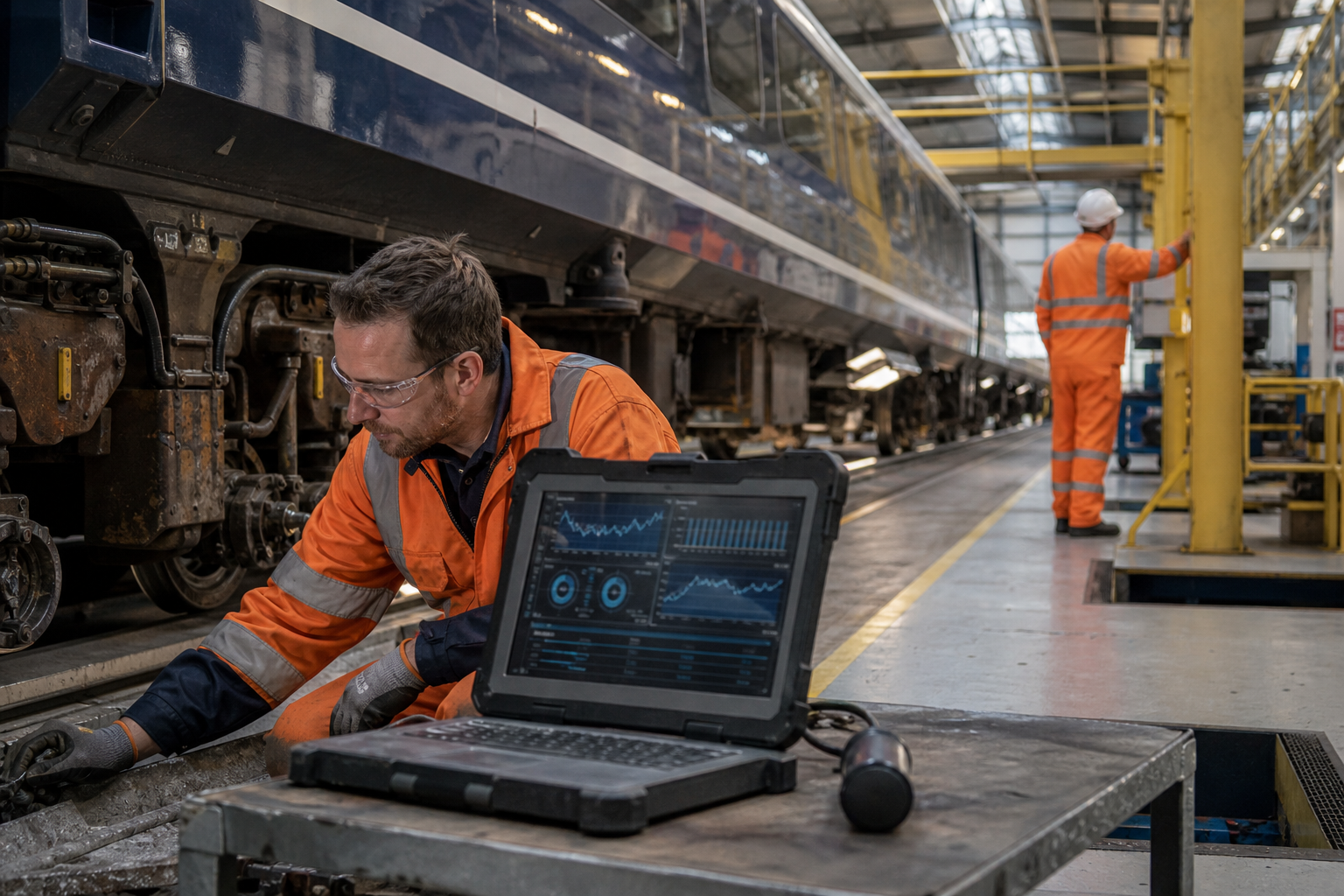
Alstom said some of its clearest returns were coming from targeted applications in maintenance and infrastructure monitoring. These include machine-learning models tracking equipment degradation and computer-vision systems monitoring infrastructure.
“An infrastructure monitoring system generates potentially millions in value without generating a single word,” Salvini said.
Henri Badaro, Alstom’s vice-president of data and AI governance, said the same principle applied to the company’s Talk to My Train demonstrator. The system uses generative AI to interpret a user’s question, then draws on operational train data, maintenance histories, engineering documents and specialist railway knowledge to provide relevant evidence.
The tool is intended to help maintenance technicians investigate faults, find similar previous incidents and identify the next action. Badaro said the challenge was not simply providing a language model with more data, but ensuring that it retrieved the right information from the right systems. “You cannot dump 7 terabytes of data directly to a computer model that just understands language,” he said.
Caution in safety-critical operations
Alstom is more cautious about using machine learning in train operations. Badaro cited lineside signal recognition, saying a statistically trained model would need to be tested across a wide range of weather and operating conditions, including leaves, wind, storms and snow.
Instead, the company uses computer-vision techniques based on defined characteristics such as track and signal geometry, which Badaro said were more readily proven and audited. Salvini said safety- and mission-critical systems needed to produce the correct answer “100% of the time”, rather than “99.8% of the time”.
Alstom is also investigating advanced robotics for inspections in factories and depots, while existing robotic applications include welding with real-time inspection. Badaro said he did not see a short-term application for what he called “physical AI”.
“Success will come from deploying the right AI in the right place with the right level of trust and governance with the right data,” Badaro said. “Most of the time, the simpler solution is the one that is the most efficient.”