

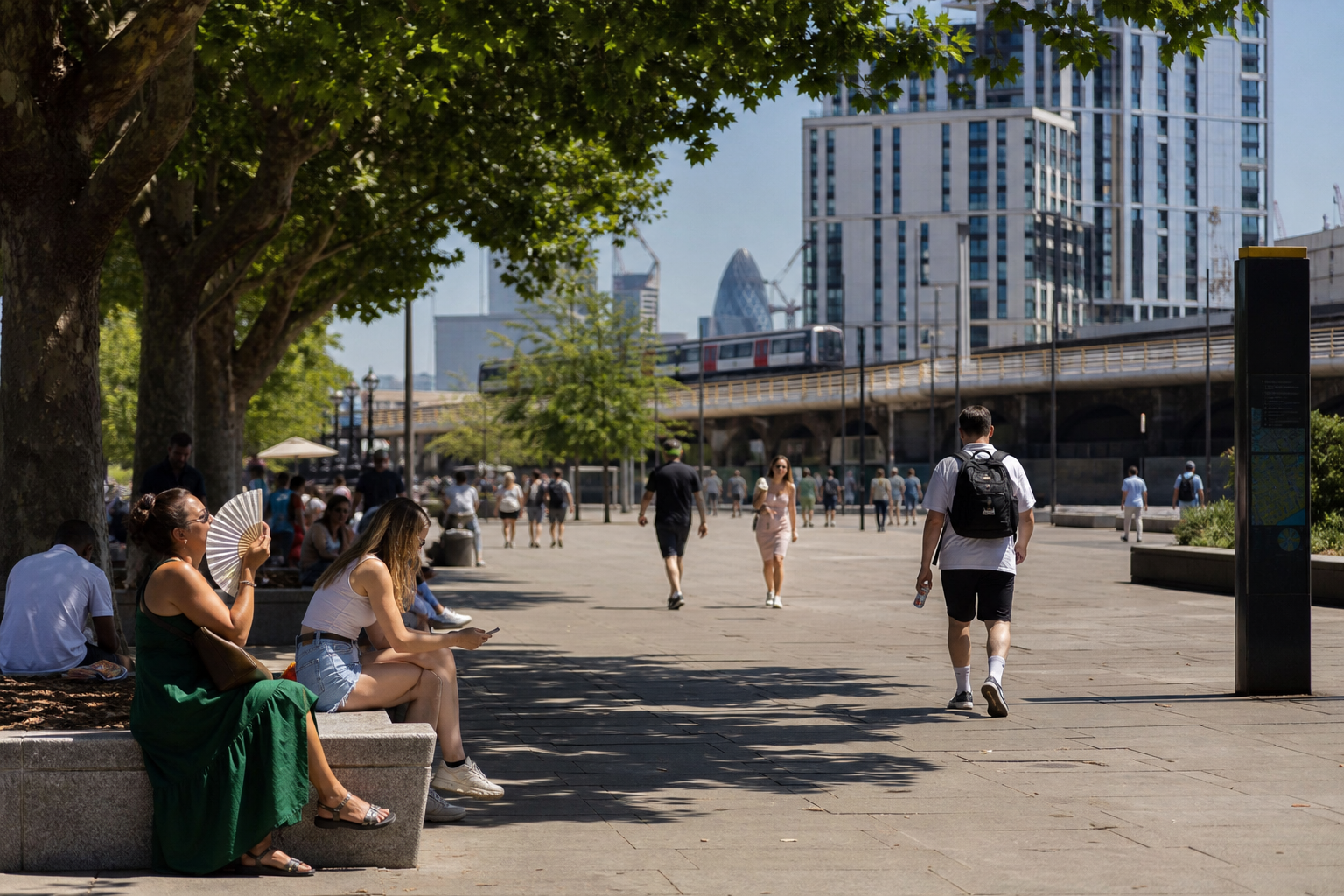
Climate change could cost London between £16bn and £36bn a year by the 2050s if further action is not taken, according to a report commissioned by the Mayor of London.
The Heat Ready London Technical Report provides the evidence behind the capital’s first city-wide vision for adapting to rising temperatures. It examines the effects of heat on health, homes, public services, infrastructure and the wider economy.
The upper estimate is equivalent to as much as 3% of London’s economy, depending on the rate of economic growth. The projected costs include lost working hours and lower productivity, increased pressure on health and emergency services, business disruption and damage to essential infrastructure.
Heat impacts already visible
The report points to the 2022 heatwave as an example of the disruption that higher temperatures can cause. Buckled rails led to cancellations and speed restrictions, while the failure of two data centres at Guy’s and St Thomas’ hospitals disrupted patient care and resulted in £1.4m of unplanned spending. London’s water consumption also increased by 50%.
Heat-related loss of productivity is estimated to cost the capital £577m a year. It accounted for almost 90% of the estimated £1.5bn cost of London’s three heatwaves in 2022, the report says.
The risks extend beyond the most extreme temperatures. Around 90% of heat-related deaths in London occur when temperatures are between 24°C and 32°C.
Investment in adaptation
Heat Ready London brings together the Mayor, London Councils, boroughs, health and care partners, emergency responders, infrastructure providers, businesses, financial institutions and community groups.
London’s parks and green spaces are estimated to provide more than £90bn in benefits over 30 years, equivalent to about £27 for every £1 invested, according to the report.
Mayor of London Sadiq Khan said: “Without further action, climate change could cost London as much as £36 billion a year by the 2050s. We must create cooler homes and buildings, greener and shadier neighbourhoods, and infrastructure that can withstand a hotter climate.”
Professor Emma Howard Boyd, chair of the National Heat Risk Commission and former chair of the London Climate Resilience Review, said the programme built on the earlier review by “turning evidence into action”. She called for statutory climate-resilience duties and funding for mayors to match their growing powers.
TfL chief safety, health and environment officer Lilli Matson said the organisation was working with agencies to manage higher temperatures across its network, including track and road-surface resilience, passenger comfort and staff welfare.
TfL is planning to introduce air-conditioned trains on the Piccadilly line and DLR, alongside new air-conditioned buses. The organisation said air-conditioned Tube trains already cover 40% of the network, while every Elizabeth line and London Overground train is air conditioned.