

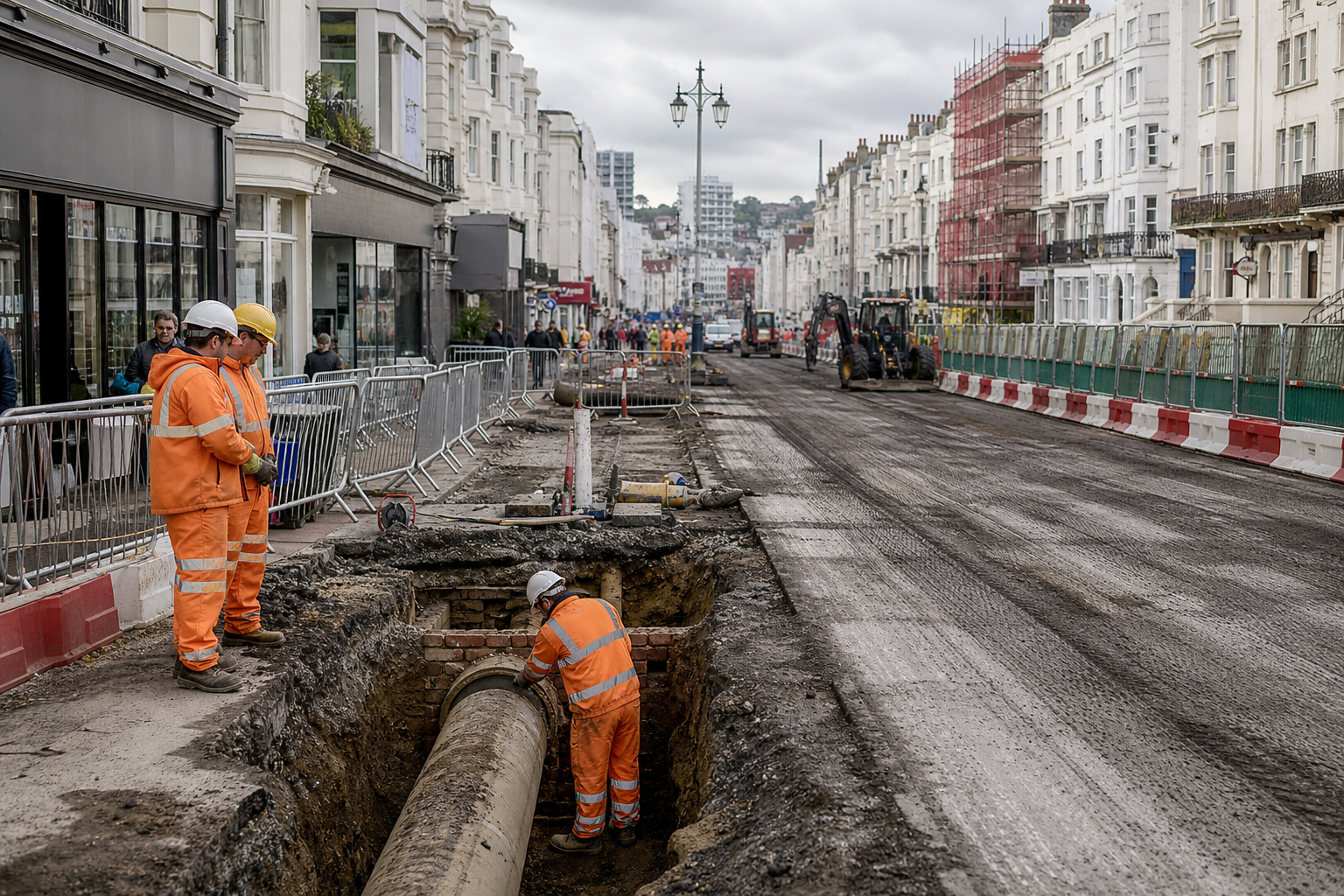
Hidden concrete poured over a water main contributed to three leaks during improvement works on Brighton’s Western Road, according to Brighton and Hove City Council (BHCC) cabinet member Trevor Muten.
The incidents occurred during the week beginning 5 October, shortly after work started on the major route. Muten said the first two leaks, reported on 5 October, were historic minor leaks that were uncovered when the road surface was removed.
“When we uncovered the surface, we uncovered those leaks, and they may have been happening for a long time,” he said.
The third incident occurred about two days later. Muten said the contractor, RJ Dance, had hit the water main, adding that a previous party had poured concrete over it when installing a gas main.
RJ Dance has been approached for comment.
Concrete complicated repairs
Southern Water took four days to stop the leaks and repair the affected mains. Muten said the utility could not complete the work on the first day because it had to break out the concrete, cap the leak and bring specialist equipment to site on 8 October before replacing a short section of water main.
He said the contractor had assessed the utilities along the route, as would normally be expected, but the concrete was not known about before the road surface was removed.
The scheme involves rebuilding the road to its clay base because of structural damage. Muten said the original plan was to use a planer to remove approximately 500mm of material, but the discovery of the concrete made that approach unsuitable.
“We had to then adapt the method […] so we took the planer off and have gone for a more targeted approach,” he said.
Muten described planing as a standard road-maintenance method but said it was not appropriate in this instance. He also said the council was unable to comment on liability for the damage and Southern Water’s repair costs.
“This road resurfacing is going at a good pace and making good progress,” Muten said. “We’re solving problems as we go. It’s not unusual for construction jobs to actually come across a few unexpected things, but we simply did all the due diligence ahead of the work.”
Underground asset data
The incidents come as the government places the National Underground Asset Register (NUAR) on a statutory footing through the Data (Use and Access) Act 2025.
The digital service provides a secure map of underground energy, water and telecommunications infrastructure across England, Wales and Northern Ireland. Ordnance Survey said in September that 400 public and private-sector organisations had added asset data during the year after the register launched.
Government calculations cited by Ordnance Survey estimate that around 60,000 accidental strikes on buried assets occur each year.