

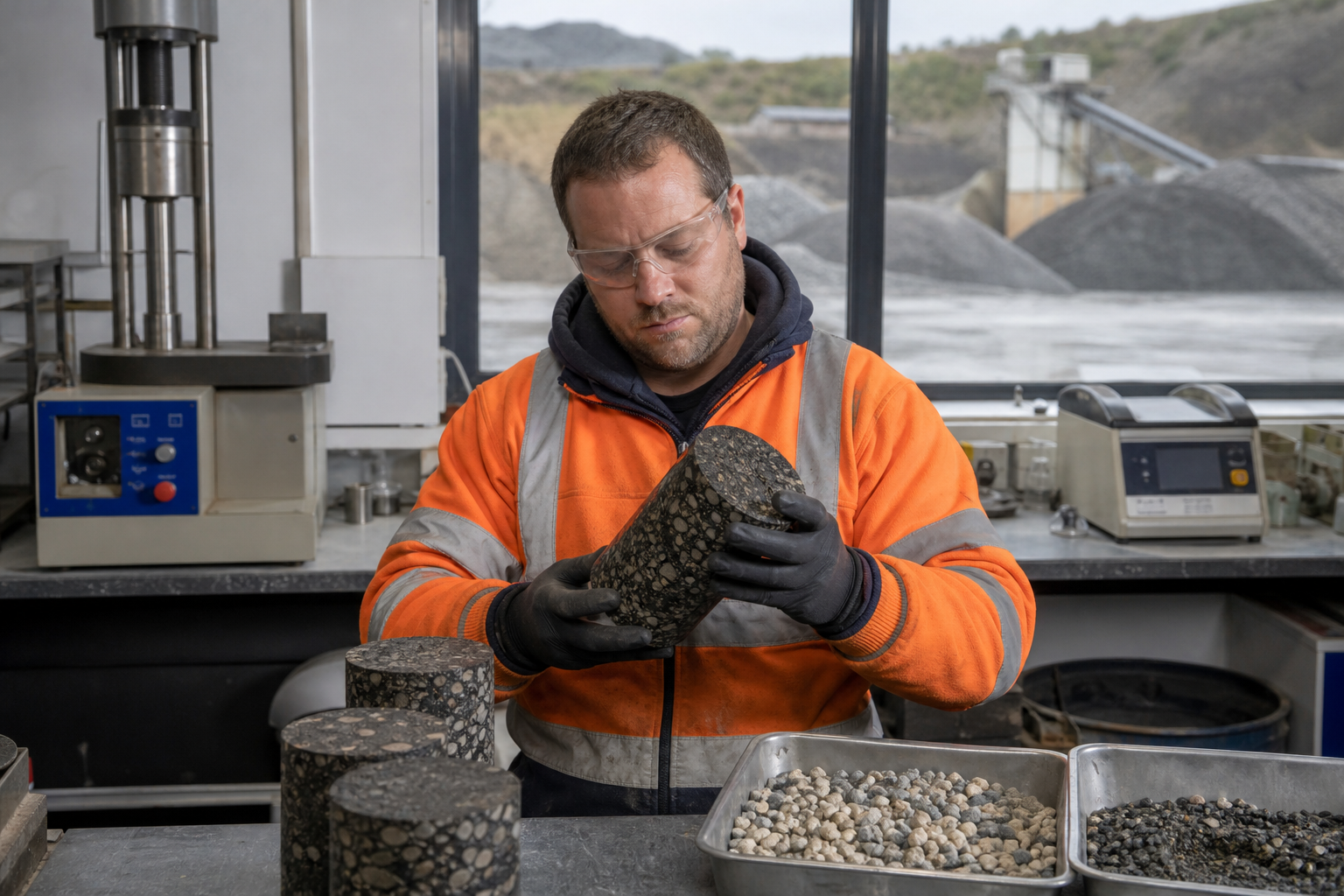
A Devon County Council laboratory is using asphalt cores, soil analysis and winter-materials testing to support maintenance decisions across England’s largest local-authority road network.
The facility, which has operated since 1952 and has been based at Rockbeare Hill Quarry since 2014, examines materials and road conditions for the council. It also undertakes work for other local authorities, developers and private businesses.
Testing roads before and after construction
Devon has more than 13,000km of roads, along with 4,834 bridges and thousands of other highway structures. The council says laboratory testing helps its asset management teams select repairs that address the cause of deterioration rather than simply treating the surface.
Core samples taken from roads under construction are assessed for asphalt type, depth, density and composition. The checks can establish whether the materials and layer thicknesses installed by contractors or utilities match the specified design.
Samples from older roads are used to understand existing condition. The laboratory also measures skid resistance and foundation strength, while its staff can identify hazardous materials before maintenance work begins.
Support for structures, drainage and winter operations
The team tests soils for bridge investigations, drainage design, slope stability assessments and surveys. It also checks the salt and brine used by Devon’s winter fleet.
Most of the laboratory’s testing has been accredited by the United Kingdom Accreditation Service since 1989, according to the council.
Laboratory manager Peter Dyer and materials engineer Graeme Peace showed the facility to councillors Neal Raleigh, Cheryl Cottle-Hunkin, James Buczkowski and Jacqueline Fry.
“This team works behind the scenes, but its expertise is built into roads and bridges across Devon,” said Cllr Raleigh.
Cllr Cottle-Hunkin said keeping the expertise in-house “means the advice is there from the earliest stage, not simply when something has gone wrong.”
Cost-neutral service
Devon County Council said income from external work makes the laboratory cost-neutral to run. Customers can use the service for investigation, testing, analysis and technical reports.
The council also links the work to waste and carbon reduction, arguing that selecting more durable materials and completing repairs correctly first time can reduce repeat interventions. Devon has previously trialled alternative repair methods through its county-wide pothole repair trial.
The council has not disclosed the laboratory’s staffing level, annual income or the number of samples it processes each year.