

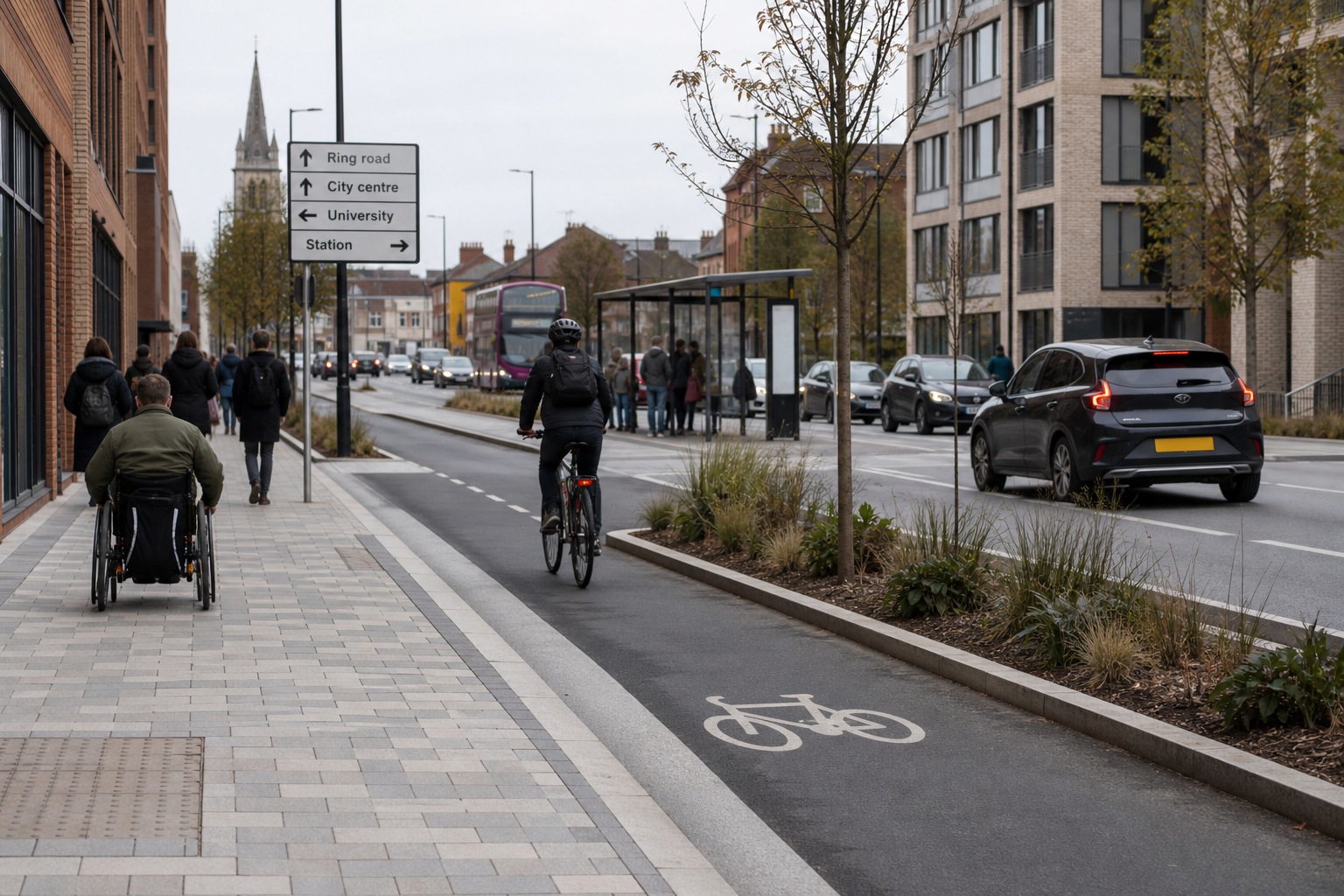
New Department for Transport guidance is changing how local authorities in England outside London are expected to prepare their future transport plans, with walking, wheeling, cycling and public transport given a more prominent role alongside driving.
The updated statutory guidance for Local Transport Plans was published in April 2026. It asks local transport authorities to take an integrated view of their networks rather than treating road capacity and vehicle movement as the starting point for every transport decision.
Active travel becomes a formal part of planning
Under the guidance, councils must set out active-travel policies in their Local Transport Plans. These policies are expected to explain how walking, wheeling and cycling will be enabled, prioritised and connected with other forms of transport.
The approach also links active travel with highway maintenance. Plans should address safety and accessibility problems affecting people walking, wheeling and cycling, bringing the condition and usability of existing infrastructure into the wider transport planning process.
Authorities are expected to build an evidence base covering current walking, wheeling and cycling patterns, potential new journeys and the barriers preventing people from using those modes. That information can then inform local cycling and walking infrastructure plans.
Wider implications for highway schemes
The guidance does not remove driving or road capacity from local transport planning. Instead, it places those considerations alongside active travel and public transport when councils assess congestion, safety, access and development-related transport requirements.
For highways teams, that could affect the development of junction improvements, corridor schemes and transport packages linked to new development. Future proposals will increasingly need to demonstrate how different modes work together within the objectives of the wider Local Transport Plan.
The DfT also connects transport planning with health, accessibility, economic activity and carbon reduction. Public transport improvements and accessibility are expected to be considered alongside walking and cycling, rather than being treated as separate policy areas.
Delivery remains the challenge
The guidance sets a planning framework rather than delivering individual projects or changing road layouts immediately. Its practical impact will depend on how councils translate the requirements into policies, funding bids, designs and schemes on the ground.
Authorities will need to address issues including route continuity, maintenance, connections to public transport and the integration of active travel with existing roads and development. The resulting priorities are likely to become clearer as new Local Transport Plans are prepared and implemented.