

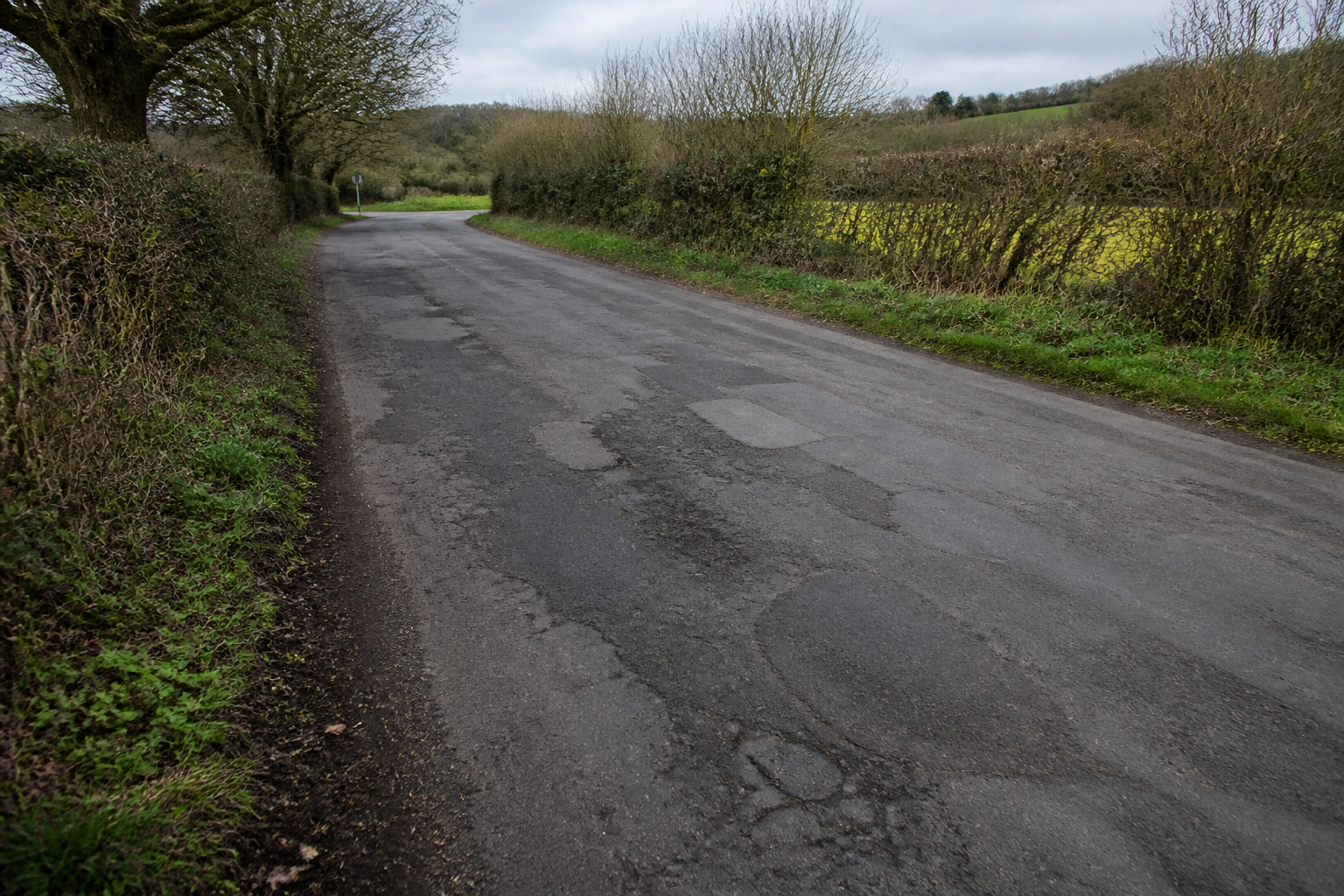
The Department for Transport has recorded 16% of England’s unclassified roads as red in the final road condition statistics to use its traffic-light assessment system.
The Road conditions in England to March 2026 release, published on 14 October, found that 4% of local A roads were red, unchanged from 2024 and 2025. The proportion of B and C roads in the red category fell from 7% to 6%.
The DfT defines a red section as one that should be considered for maintenance. It does not necessarily mean that treatment is required, but indicates that the road should be investigated fully.
Final comparable results
Across local A roads, 28% was classified as amber and 68% as green. However, the national average masks significant differences between authorities. Of the 147 councils supplying comparable data for 2024 and 2026, 66 saw the proportion of red A roads increase.
Brighton & Hove had the highest reported share, with 17% of its A roads categorised as red.
Unclassified roads account for about 62% of council-managed roads. Their condition data is collected over a four-year cycle because of the size and variety of the network, meaning the results change more slowly and are less precise than those for other road classes.
The DfT cautions that the traffic-light percentages relate to road length rather than the number of roads. Survey vehicles assess short sections, with scoring methods varying by road class to reflect maintenance priorities and traffic levels. As a result, a red section of an A road cannot be directly compared with an amber section of a B road.
Maintenance activity increases
Around 10,000km of local road received maintenance treatment in 2026, according to the DfT. That was 6.5% more than the approximately 9,400km treated in 2025.
On the strategic road network, which represents about 2% of England’s roads but carries around 34% of traffic, National Highways met its target for 96.2% of the network to require no further investigation.
New standard will break the time series
The DfT adopted the PAS 2161 Road Condition Monitoring standard in April 2026. From 2027, road condition statistics will use five categories instead of red, amber and green.
The new categories will not be directly compatible with the previous system, ending a comparable time series that extends back to 2008. The 2026 results therefore represent the final like-for-like benchmark under the former methodology.