

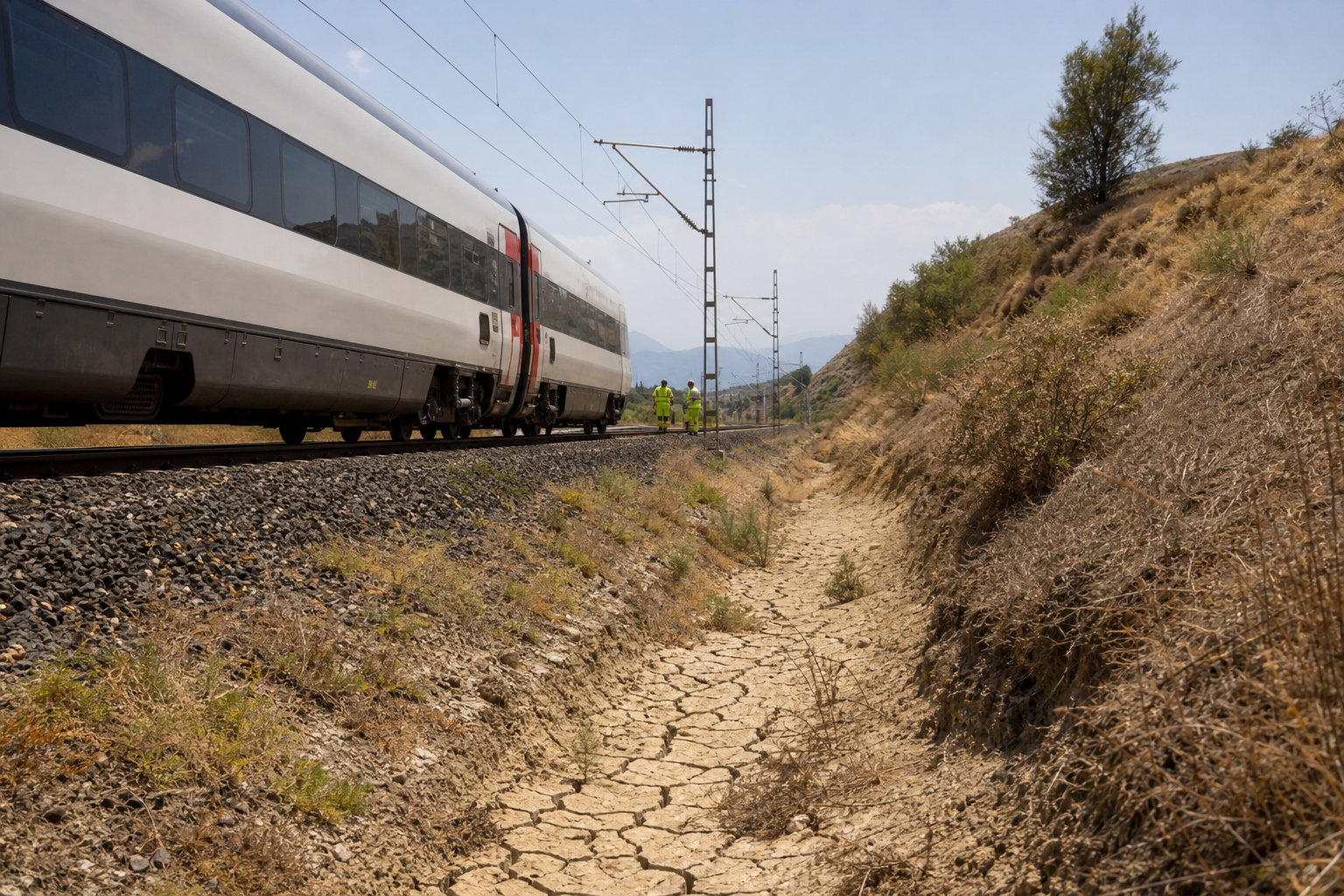
Climate change is shifting from a political advantage for rail into a major operational and investment challenge, as extreme weather increasingly disrupts networks and exposes weaknesses in infrastructure, according to Railway Gazette International Executive Editor Nick Kingsley.
Writing in a commentary, Kingsley said rail had previously been presented as a key beneficiary of efforts to move passengers and freight from higher-emission transport modes. But the sector is now facing the direct consequences of a changing climate, including hotter summers, more intense storms and prolonged drought.
Heat and fire disrupt networks
Railways were on the front line of heatwaves across Europe during the summer of 2026. Wildfires closed sections of the network in southern France, while Hungary imposed restrictions on freight train operations because of pressure on the electricity grid.
In south-east England, two passenger trains derailed on successive days during a period of extreme heat and dry weather. The causes of the incidents near Lewes and Wickford had not been confirmed, and the Rail Accident Investigation Branch was expected to take time to assess the circumstances.
Both derailments occurred within 24 hours of the UK Met Office declaring 13 August the country’s fifth-hottest day on record. Network Rail Group Engineering & Safety Director Martin Frobisher said the “unprecedented hot and dry weather” had presented “exceptional challenges to the railway”, while reaffirming the infrastructure manager’s commitment to making climate resilience central to its investment plans.
Risks extend beyond railway assets
Kingsley said railway managers would need to review measures including rail stressing, overhead-line tensioning and the performance of air-conditioning systems on trains if higher summer temperatures become the norm.
However, some of the most significant risks sit outside the railway’s direct control. Hungary’s traction-energy restrictions were linked to concerns about the country’s power grid after record-low Danube water levels threatened the operation of its only nuclear power plant. Low water levels on the Rhine have also raised questions about the future reliability of inland shipping.
A sustained shift of freight from waterways to rail could create an opportunity for operators, but only if neighbouring rail networks have enough capacity to absorb the additional traffic. Current network constraints suggest that this cannot be taken for granted, Kingsley said.
Similar issues are being reported beyond Europe. In Canada, the crew of a Canadian National freight train had to be evacuated after the train became trapped by a wildfire in mid-July. Wildfires have also become more widespread in North America and Australia.
Resilience without losing capacity
Railways must prepare for more intense autumn and winter storms as well as hotter summers, placing additional pressure on legacy assets that were not designed for such extremes. Yet the required investment comes as governments face tighter public finances.
Kingsley warned against focusing solely on protecting existing services at the expense of improvements and capacity expansion. He argued that the industry should prioritise measures that strengthen climate resilience while also improving railway performance and delivering value for money.
The issue is expected to feature prominently at InnoTrans in Berlin, where the European Train organised by Europe’s Rail will bring sector stakeholders together in September. The event will also give European railways an opportunity to learn from operators in regions accustomed to more extreme heat, storms and winter conditions.