

Four of ten UK highways innovation trials reviewed by Highways Industry have been adopted or approved for wider use, while two others have been extended.
The review examined pilots launched between 2021 and 2025, covering automated traffic management, road surfacing, vehicle enforcement, street lighting, alternative fuels and pothole repairs. Two trials had no published outcome by 22 October 2026.
The trials classed as adopted or approved involved automated cone laying, SwiftGate taper gates, Leicestershire’s earlier street-light dimming and hydrogen fuel for the Lower Thames Crossing.
Four trials move beyond pilots
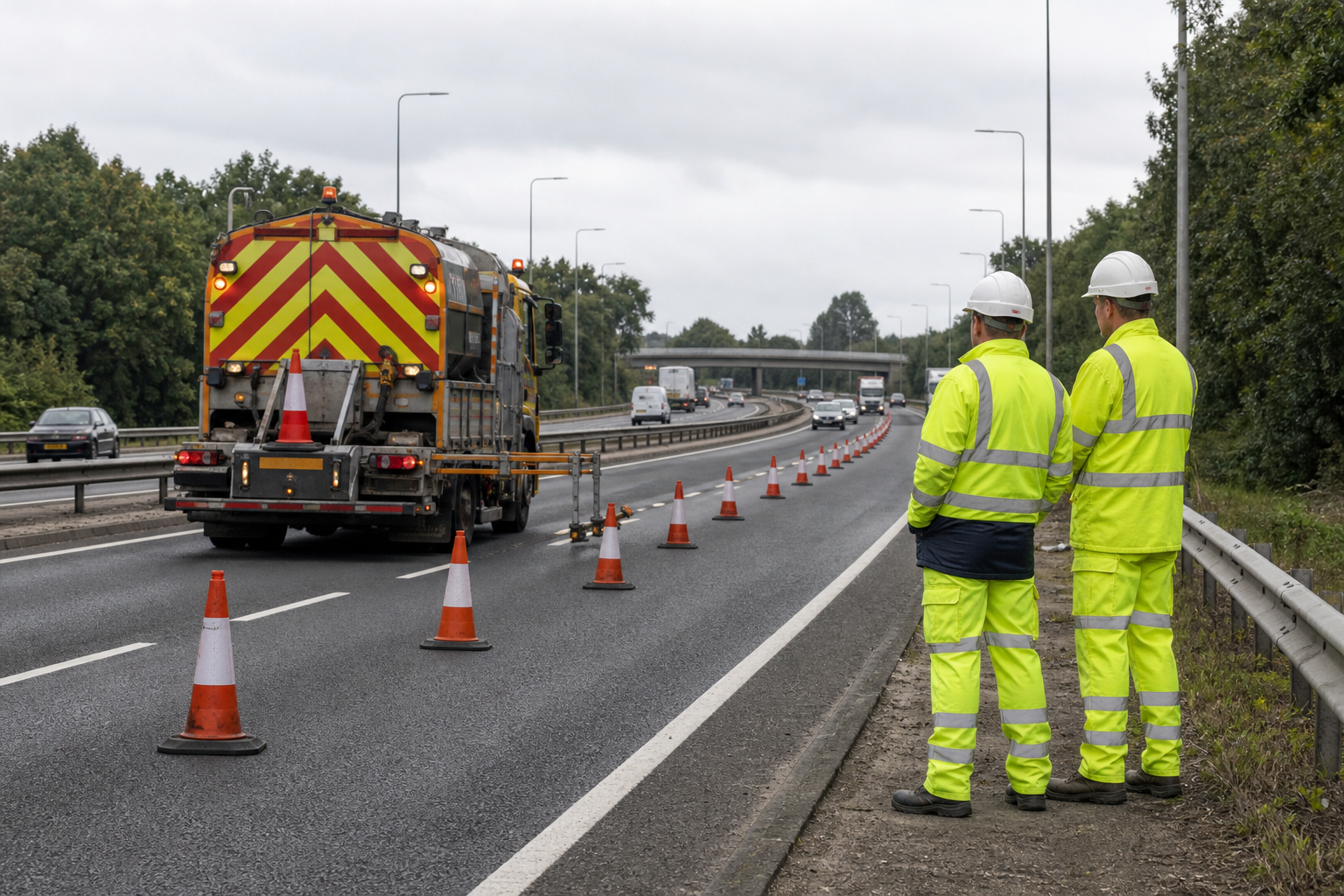
Highway Care’s Falcon automated cone-laying machine was trialled through a National Highways innovation project led by Kier in 2021. The machine is designed to place and collect cones without operatives lifting them from a moving vehicle.
Connect Plus Services introduced the equipment on the M25 in July 2022, after Balfour Beatty described the move as the first UK construction-company rollout. Highway Care launched a smaller Falcon 75 model for local-road projects in 2025. The number of machines in service has not been published, and no outcome was found for a separate King Highway Products machine tested off-road.
SwiftGate, developed by Highway Care and trialled by National Highways and Kier at the A3 Hindhead Tunnel in 2022, was endorsed for use on the road network in England and Wales, according to Highway Care in September 2024. The company said its automated taper took an average of 2 minutes 34 seconds to deploy, compared with 7 minutes 30 seconds for cones, and 40 seconds to retract against 4 minutes 20 seconds.
Those timings are supplier figures. The review found no Department for Transport record of the endorsement, separate National Highways evaluation or published list of sites using SwiftGate.
Leicestershire County Council has approved continued dimming of street lights to 30% from 20:00 to 07:00. Its trial began in January 2024, bringing forward the start of dimming from 22:00, with exceptions including zebra crossings.
The council’s September 2025 cabinet decision recorded annual energy-cost savings of £540,000 and a carbon reduction of 319.3 tonnes. Earlier estimates had put annual savings at about £380,000 and carbon savings at roughly 260 tonnes once exceptions were included.
On the Lower Thames Crossing, hydrogen combustion-engine equipment was trialled with JCB and Ryze Power. National Highways later awarded GeoPura a £32.6m contract for 2,500 tonnes of hydrogen. The contract was concluded on 18 August 2025 and announced on 23 February 2026.
A JCB hydrogen machine was used by Skanska for ground investigation near Gravesend in October 2025. The stated ambition is to remove diesel from worksites by 2027, but it is too early to assess whether that target will be met.
Two trials extended, while noise-camera rollout stalls
Devon County Council has expanded its trial of fixing nearby potholes during the same visit. The initial seven-week scheme ran from September 2025 in parts of Barnstaple, Hatherleigh, Chagford and North Tawton.
Inspectors looked for potholes within 500 metres of a reported defect, or as far as the nearest junction. The council’s May 2026 cabinet report said about £300,000 was spent in the trial areas, fixing around 10% of the defects identified. It concluded that the approach could not be adopted across the county in its current form, but approved a further 12-month trial. Possible changes include limiting repairs to potholes immediately near another defect.
A separate National Highways and AECOM trial used artificial intelligence and human checks to identify drivers using handheld phones or travelling without seatbelts. A 2022 deployment with Warwickshire Police examined about 122,000 vehicles on the M40 and A46 in 64 hours, identifying 664 offences.
The trial was extended to ten police forces until March 2025, but the review found no published final evaluation or national rollout decision from National Highways. Sussex Police, one of the participating forces, began using Acusensus cameras independently in April 2026 and reported about 700 offences during the first week.
Noise cameras, tested by the Department for Transport between October 2022 and February 2023, produced a published evaluation but no national rollout. Trials in Keighley, the Bristol area, Great Yarmouth and Rubery in Birmingham were backed by £300,000.
The DfT’s March 2024 research found that 4% of about 1,800 camera activations were attributable to excessively noisy vehicles. It supported a threshold of 95 dB LAmax at 7.5 metres on roads with speed limits of 50mph or below. The research also estimated that a camera would be cost-neutral with at least two genuine activations a day.
In a written answer in June 2025, transport minister Lilian Greenwood said the department did not plan to produce further guidance on noise cameras. Enforcement remains the responsibility of local authorities and the police.
Three trials ended or have no published result
Nottingham City Council’s wireless taxi-charging trial ended in January 2023, with the charging pads removed so the site could return to use as a standard taxi rank. The £3.4m WiCET project, led by Cenex and funded by the Office for Zero Emission Vehicles with support from Innovate UK, opened to the public in September 2022.
Nine electric hackney taxis used the 10kW charging system at Trent Street near Nottingham Station. The council recorded almost 1,000 charging events involving more than 20 drivers over four months. Drivers valued the convenience but many wanted faster charging. Coventry University lists the project as completed on 31 March 2023, although no final report was found.
There is no published outcome for Buckinghamshire Council and Roadfill’s recycled-plastic asphalt trial. The material, containing less than 1% plastic, was laid on the A40 Oxford Road in Denham and Orchard Way in Holmer Green in November 2022. The council had planned an initial 12-month performance assessment, but no result has been released.
Similarly, no results have been published for the trial of Low Carbon Materials’ ACLA carbon-negative aggregate on the M11 northbound between junctions 7 and 8 in Essex. The 2024 scheme included a control strip and involved Skanska and Tarmac. National Highways was expected to compare durability under traffic, but the review found no published findings.
The review said an absence of published results does not demonstrate that either material failed. It identified a common feature among the trials that progressed: the organisation expected to use the innovation also funded or ran the test, measured performance against an existing method or pre-set target, and retained a clear decision-maker at the end.