

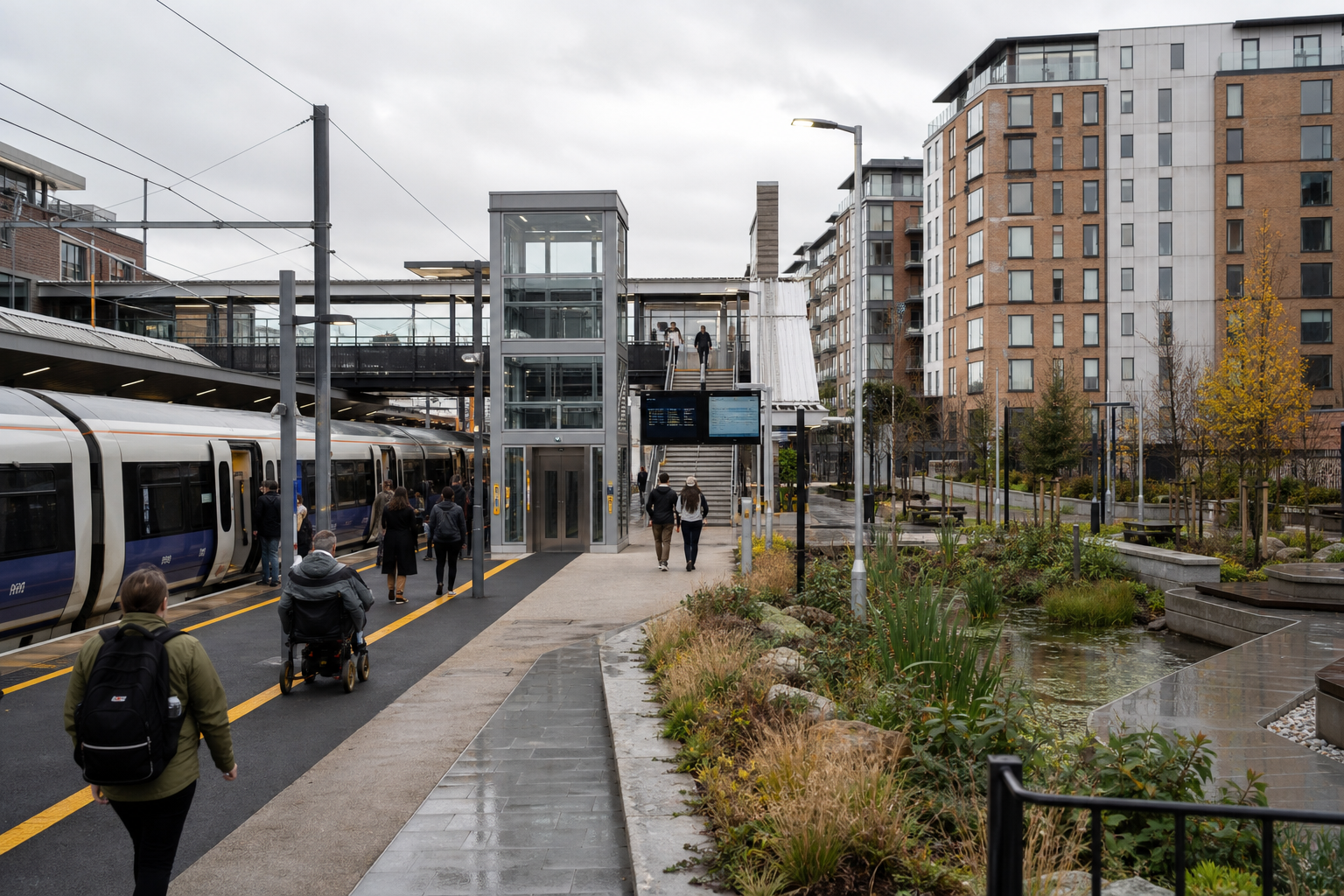
Rail stations will need to operate as resilient civic infrastructure rather than passenger facilities alone as Great British Railways reshapes the sector, according to Ramboll UK&I rail director Trina Minchella.
In an analysis of Nordic rail projects, Minchella argues that rising climate, security and social pressures require resilience to be embedded in station governance, investment decisions, operations and performance measurement.
Designing for disruption
Nordic countries have long designed infrastructure for harsher climatic and geopolitical conditions. Minchella points to Copenhagen’s S-train system as an example of how integrated asset management can link infrastructure, rolling stock, organisational capability and investment priorities.
She also highlights the depots built for Copenhagen’s Ring 3 light rail, which were elevated to reduce flood risk. The line’s connection to the S-train network is intended to support continuity across the wider urban system, rather than protecting an individual facility in isolation.
Stations depend on a network of power, signalling, drainage, telecommunications, roads and utilities. Failures in one system can therefore spread to others, making coordination and redundancy central to resilient design.
The Follo Tunnel between Oslo and Ski provides one example. Its delivery used mobile broadband, GSM-R and TETRA emergency communications, with railway and emergency systems separated and supported by redundant arrangements. Active and passive equipment was placed in technical rooms so that services could continue while maintenance was carried out.
At Nittedal station in Norway, the existing fibre network had to remain operational during construction. The response included a redundant transmission network, accessible public information systems and carefully phased works to protect live operations.
Lessons for the UK rail estate
Minchella says the organisation of projects is as important as their technical design. Helsinki’s Light Rail Line 15 opened early and under budget using an Alliance Model based on shared objectives and transparency, which she identifies as a way of reducing fragmentation and improving risk management.
Sweden’s Bohusbanan railway used condition surveys, prioritisation matrices, risk identification, whole-life costing and value-engineered remedial options to guide tunnel rehabilitation. The approach could help UK station owners prioritise interventions across ageing estates, rather than defaulting to wholesale replacement.
Several UK schemes demonstrate how accessibility, buildability and place can be considered together. The Step Free Access programme at Harrow-on-the-Hill, Amersham and Osterley used building information modelling, laser-scan data and prefabrication to integrate lifts, bridges and other station improvements while limiting disruption.
Minchella also cites Tottenham Court Road, where residential development and ground-floor retail were integrated with the station and surrounding streetscape.
Stations as community resilience hubs
Finland’s comprehensive security model treats transport, energy and communications as connected systems requiring coordinated action from public and private organisations. Minchella argues that the UK has many of the technical building blocks needed to apply a similar approach.
Future station briefs should therefore consider what a major station could realistically provide during a flood, heatwave or power outage. That could include resilient power and water supplies, communications, accessible routes, passenger information and flexible space, agreed with local resilience forums and designed into the project from the outset.
The aim would not be to turn every station into an emergency centre. Instead, stations with the appropriate scale, location and connections could continue supporting their communities when surrounding systems are under strain.
“We shouldn’t judge stations on passenger throughput alone,” Minchella argues, pointing instead to the resilience of organisational planning, climate-ready assets, coordinated interdependencies, maintainability and planned civic value.
Her conclusion is that Great British Railways does not need to replicate the Nordic model. It can adopt the underlying principle of treating resilience as a strategic outcome, rather than a compliance requirement, when stations are planned, funded and delivered.