

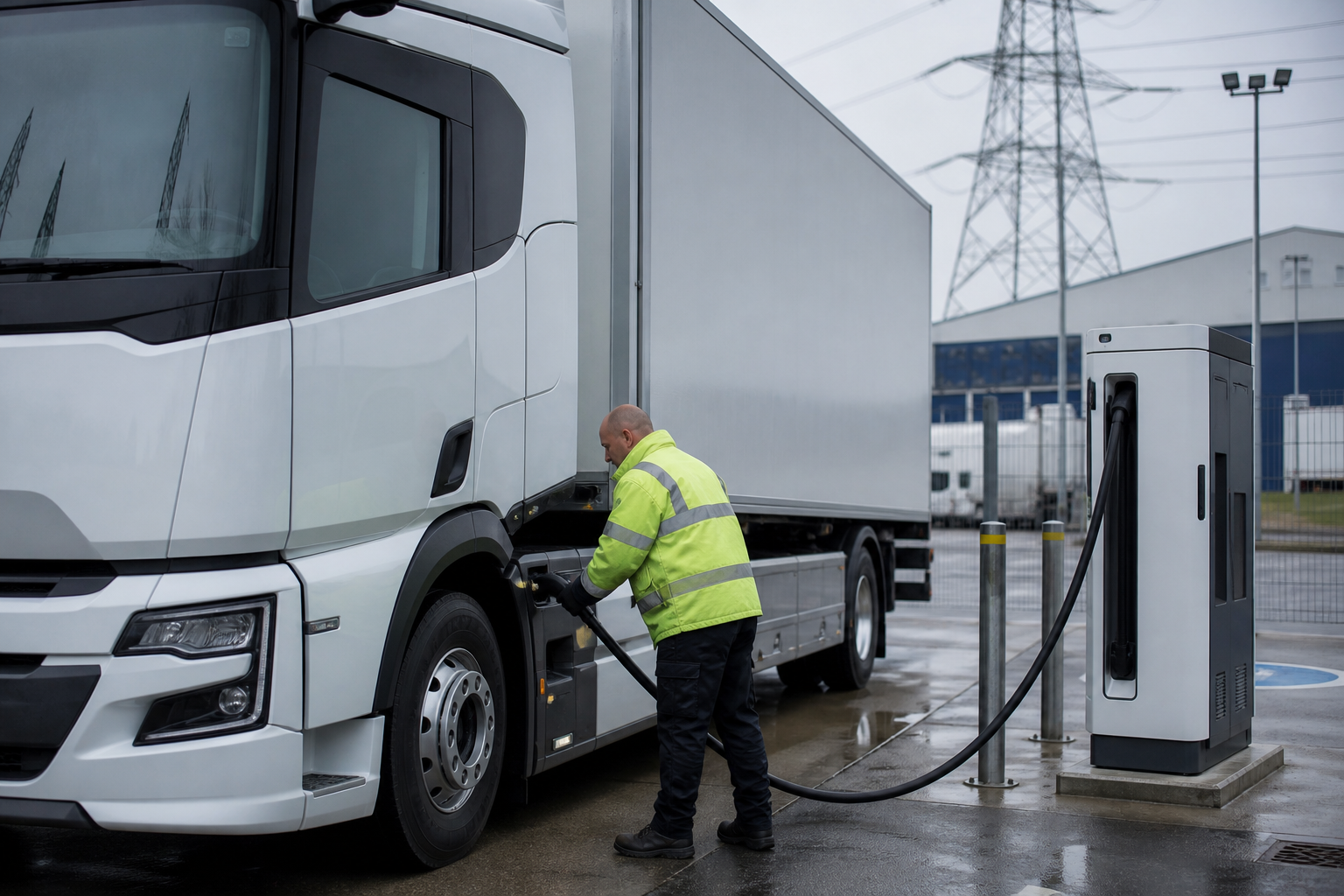
Grid connection delays, high electricity costs and financing risks are slowing the move to electric heavy goods vehicles, according to a report from the Aldersgate Group and the Renewable Energy Association (REA).
Ready to Move: a framework for decarbonising UK HGVs, published on 22 October 2026, says only around 1,600 of the UK’s 521,000 licensed lorries were zero-emission in June. That represents approximately 0.3% of the total fleet.
Zero-emission trucks accounted for 1.1% of new HGV registrations in the third quarter of 2026, according to the Society of Motor Manufacturers and Traders.
Call for a single transition plan
The report calls for the government to create one transition roadmap, with responsibilities and milestones shared across departments. Its recommendations are centred on a long-term policy framework, measures to reduce investment risk, and energy and charging infrastructure planned ahead of demand.
The groups support the existing 2035 and 2040 phase-out dates for new non-zero-emission HGV sales. They also want the government to set out a clear, time-limited role for low-carbon fuels in areas where zero-emission vehicles are not yet practical.
Rachel Solomon Williams, executive director of the Aldersgate Group, said: “Record diesel prices have shown how exposed our supply chains are to fuel price shocks.”
Infrastructure investment ahead of demand
For the highways and energy sectors, the report recommends that freight is included in energy and network planning. It calls for investment ahead of need at logistics hubs and along freight corridors, as well as faster and simpler grid connections.
It also recommends support for shared charging facilities and battery storage where these can reduce costs. The report argues that making electric HGVs available will not, by itself, resolve constraints involving depot capacity, connection lead times, electricity prices, finance or planning.
The call comes as the average UK diesel price has exceeded £2 a litre for the first time, according to the RAC. The report was published ahead of the Autumn Budget on 28 October and the government’s response to its consultation on a new HGV carbon dioxide emissions framework.