

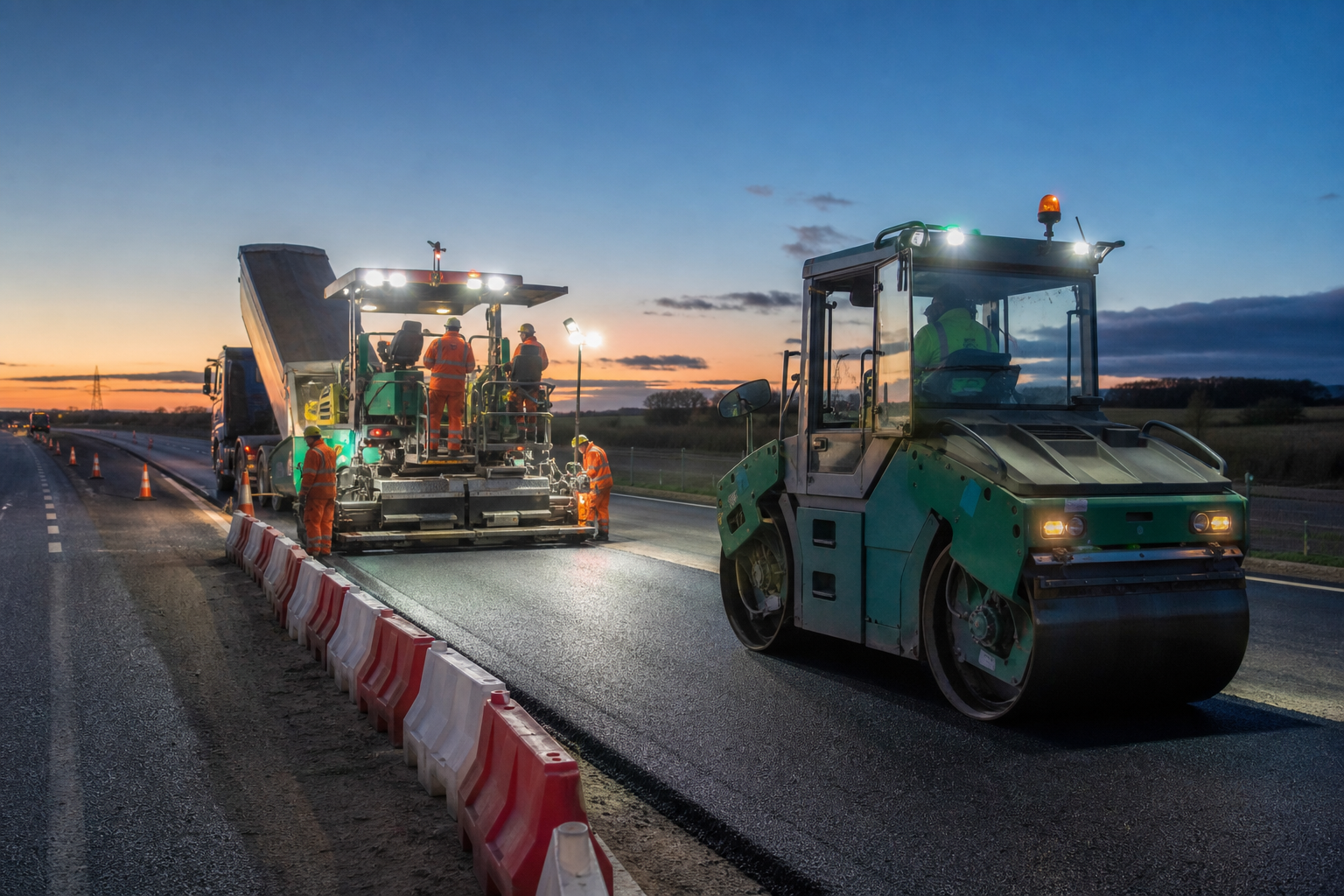
National Highways says a programme of 11 road construction and resurfacing schemes has saved around 4,500 tonnes of CO₂ through lower-carbon methods and materials.
The projects, delivered over the past year through the organisation’s Low Carbon Demonstrator Fund, trialled 15 techniques. The reported savings include emissions generated during construction and those expected over the road surfaces’ lifespans.
National Highways is investing around £2.5m in the fund, which is intended to help move market-ready technologies into wider use across England’s strategic road network.
Longer-lasting materials
Several schemes used long-life binders designed to improve pavement resilience and reduce the need for future maintenance. Holcim estimated that a binder used on resurfacing works on the M5 between junctions 28 and 30 could extend the surface’s service life from 15 to 20 years.
Neil Leake, Holcim’s national technical manager for contracting, said: “Making roads last longer is the most effective form of carbon reduction. Employing materials and technologies like these is essential for pushing the industry toward a more sustainable future.”
Electric and hydrogen-powered equipment
On the M4 between junctions 15 and 16, FM Conway used an electric roller, an electric paver and a hydrogen loader alongside low-carbon asphalt. The project has been shortlisted in the innovation category at the 2026 Highways Awards.
Andy Weymouth, framework delivery manager at FM Conway, said the scheme demonstrated how collaboration could “accelerate the transition to greener infrastructure” on the strategic road network.
On the A47 between Acle and Yarmouth, Heidelberg Materials estimated that an electric paver could reduce the carbon associated with road-laying equipment by up to 70%. The scheme also used cold recycled bound materials, allowing existing road material to be reused and manufactured at a lower temperature.
Scott Cooper, managing director of contracting at Heidelberg Materials UK, said the material, known as evoBuild foamed asphalt, was produced by injecting water and air into hot bitumen under high pressure.
Scaling up lower-carbon resurfacing
Angela Halliwell, National Highways’ head of carbon and air quality, said the fund was helping the organisation decarbonise road construction and maintenance. She added that the projects could lead to “industry-wide changes”, including carbon savings, improved roads and quieter roadworks.
National Highways said the trials were designed to show how multiple market-ready materials, technologies and construction techniques could be combined rather than deployed in isolation. The results are intended to help remove barriers to wider adoption and make low-carbon resurfacing routine.