

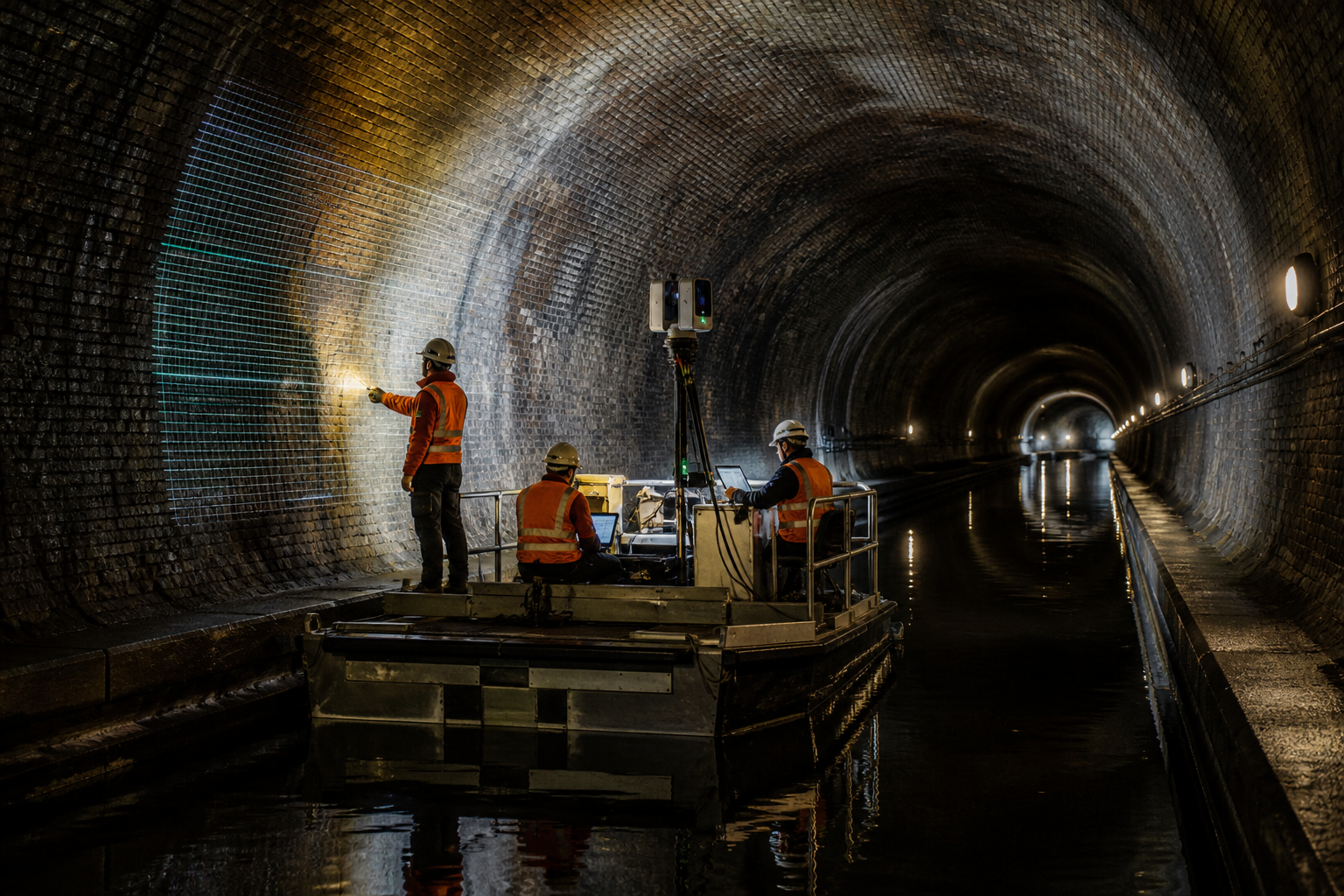
Non-intrusive inspection technologies have helped reduce the expected cost and disruption of assessing Islington Tunnel, according to project teams working for the Canal & River Trust (CRT).
Arcadis was appointed by CRT in 2025 to survey, inspect and assess the 878m-long tunnel, which carries the Regent’s Canal beneath Islington. The brick-lined structure was completed in 1818 and opened in 1820.
Muon imaging locates hidden shaft
The assessment was complicated by the tunnel’s constant water level, lack of an internal towpath and more than two centuries of soot and deposits. The structure also sits beneath a major highway, with changing traffic loads and vibration adding to the risks being considered.
Arcadis used muon imaging, which tracks subatomic particles generated by cosmic rays, to investigate a potential historic construction shaft behind the tunnel lining. The survey focused on a section around 150m along the tunnel and used 41 monitoring stations.
Andrea Gillarduzzi, Arcadis geotechnical sector director, said the method avoided an estimated six months of ground investigation. The results identified the shaft’s position and enabled the team to assess whether it posed a structural risk.
“The shaft could have been identified with extremely high effort, extensive investigation. But by using alternative technology, an estimated six months of ground investigation was saved,” Gillarduzzi said.
Digital model combines inspection data
CRT also used sonar to survey the tunnel below the waterline. CRT principal engineer for tunnels and culverts Peter Simpson said it was the first time the organisation had successfully completed an accurate full sonar survey through one of its tunnels, where GPS-linked software cannot operate normally.
Arcadis brought the survey results together in Smart Atlas, a geospatial platform that combines archive records, structural assessments, geological and utility data, reality capture and muon imaging. The platform creates a digital representation of the asset that can be reviewed remotely and explored in three dimensions.
The project team estimates that the combined approach could eliminate five site inspections, 250 hours of work on site and up to 10t of carbon emissions. It also estimates a saving of about £500,000 by avoiding additional surveillance and ground investigation that would otherwise have been required.
“The tunnel was in better condition than we expected,” Simpson said. The results have allowed CRT to prioritise investment elsewhere while providing a clearer basis for addressing the tunnel portals, which have been remediated several times.
Technology supports future maintenance
Not all parts of the structure produced equally positive results. The portals required further manual surveys, while restricted working space meant the team had to develop a scanning arrangement using a stabilised barge.
The digital model is intended to support future maintenance as well as the current refurbishment planning. CRT can use it to review records remotely, simulate interventions in the confined tunnel environment and give site teams access to inspection information through tablets and augmented-reality tools.
Arcadis business director Philippa Spencer said accessible digital interfaces could also help staff with varied technical backgrounds interpret inspection reports and make decisions about ageing infrastructure.
CRT manages more than 3,000km of waterways, including 57 tunnels and about 2,000 culverts dating back as far as 250 years. The Islington Tunnel project is being used to test how connected inspection data and non-intrusive technologies can be applied to other historic assets.