

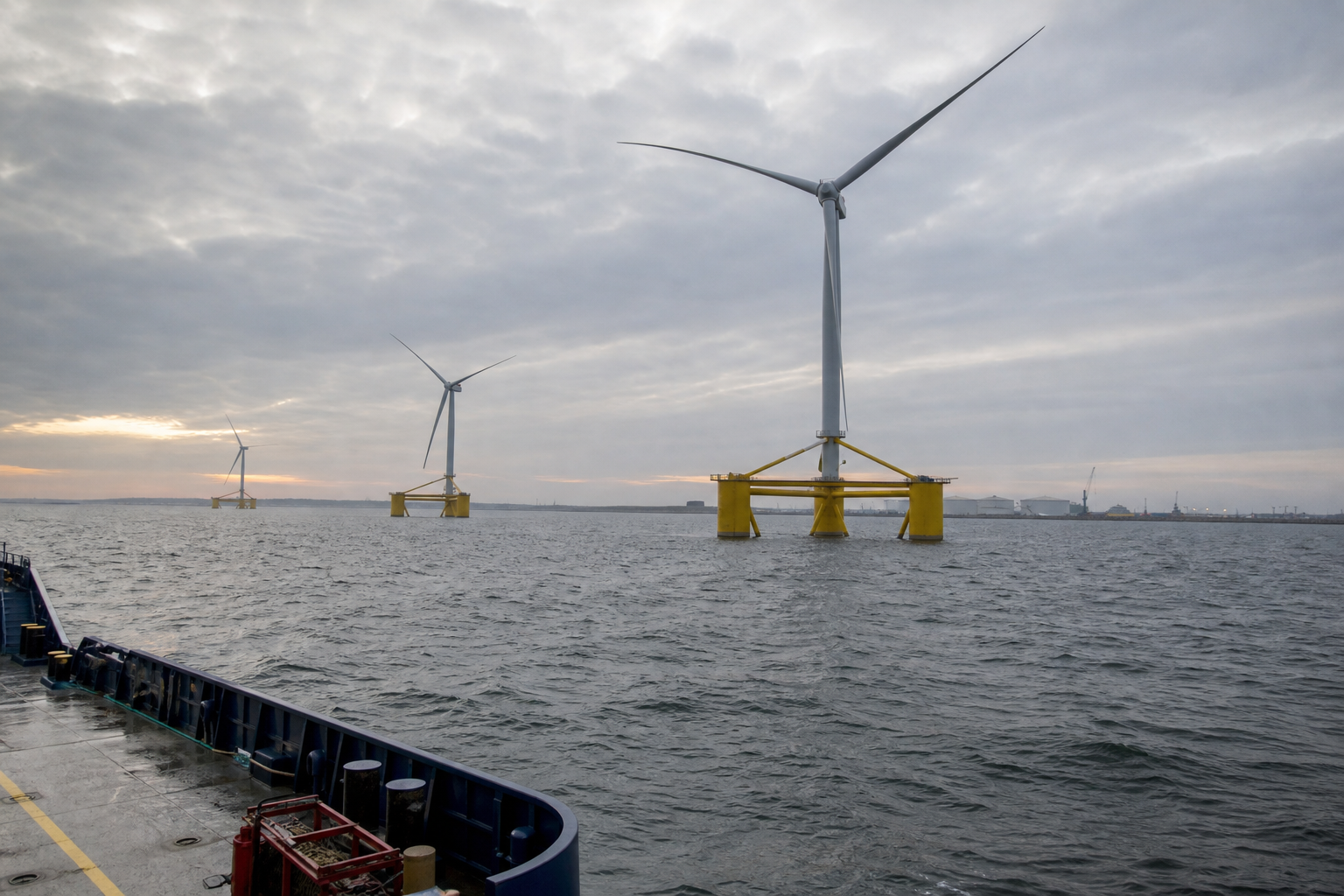
ORE Catapult has published an updated framework for reducing the cost of floating offshore wind, as the sector moves from demonstration projects towards commercial-scale deployment.
The Cost Reduction Monitoring Framework methodology report, produced for the Floating Offshore Wind Centre of Excellence and the Floating Wind Executive, identifies the cost of capital as the largest single constraint on the technology’s development.
Manufacturing and supply chain priorities
The framework highlights advanced manufacturing, automation and higher production volumes as routes to lower unit costs. It also calls for designs that use less material without compromising structural performance, alongside more efficient logistics, shorter manufacturing timescales and greater convergence between project designs.
ORE Catapult said standardised and simplified designs could reduce engineering complexity and support more modular approaches to fabrication.
The report also identifies external factors that can affect project costs, including Bank of England base rates, steel and concrete prices, vessel day rates, labour costs and exchange rate volatility.
Capacity constraints
ORE Catapult’s analysis models fabrication taking place overseas, elsewhere in Europe or in the UK. It concludes that the balance between fabrication location and available local capacity will influence the final cost of projects.
Other practical constraints identified in the report include port and fabrication capacity, vessel availability, grid connections and the limited operational track record of floating wind.
Floating offshore wind has substantial potential in deeper waters, with available capacity estimated at more than four times projected future electricity demand. The sector is currently being supported by policy mechanisms, port investment and strategic leasing rounds while it develops beyond small-scale demonstrations.
The UK currently has 77.5MW of operational floating offshore wind capacity across two projects: the 30MW Hywind Scotland scheme, which began operating in 2017, and the 47.5MW Kincardine project, operational since 2021. The UK accounts for approximately 14% of global floating offshore wind generation capacity and ranks second behind Norway, which has 100MW across three projects.
Government response
Sarah James, director of renewable electricity at the Department for Energy Security and Net Zero, said: “Floating offshore wind has significant potential to contribute to the UK’s future energy security, but realising that potential will require coordinated efforts to reduce costs and move towards greater competitiveness with other forms of electricity generation.
“Government and industry want to build on our early success in the floating offshore wind sector to support growth and jobs across the UK, and enhance our energy security through home grown, clean power.”
James added: “As we invest to develop the technology, we can only ensure the long-term growth of floating wind is sustainable by making sure it is affordable for consumers.
“This report is a major step forward in our understanding of what will drive cost reductions within floating wind.”