

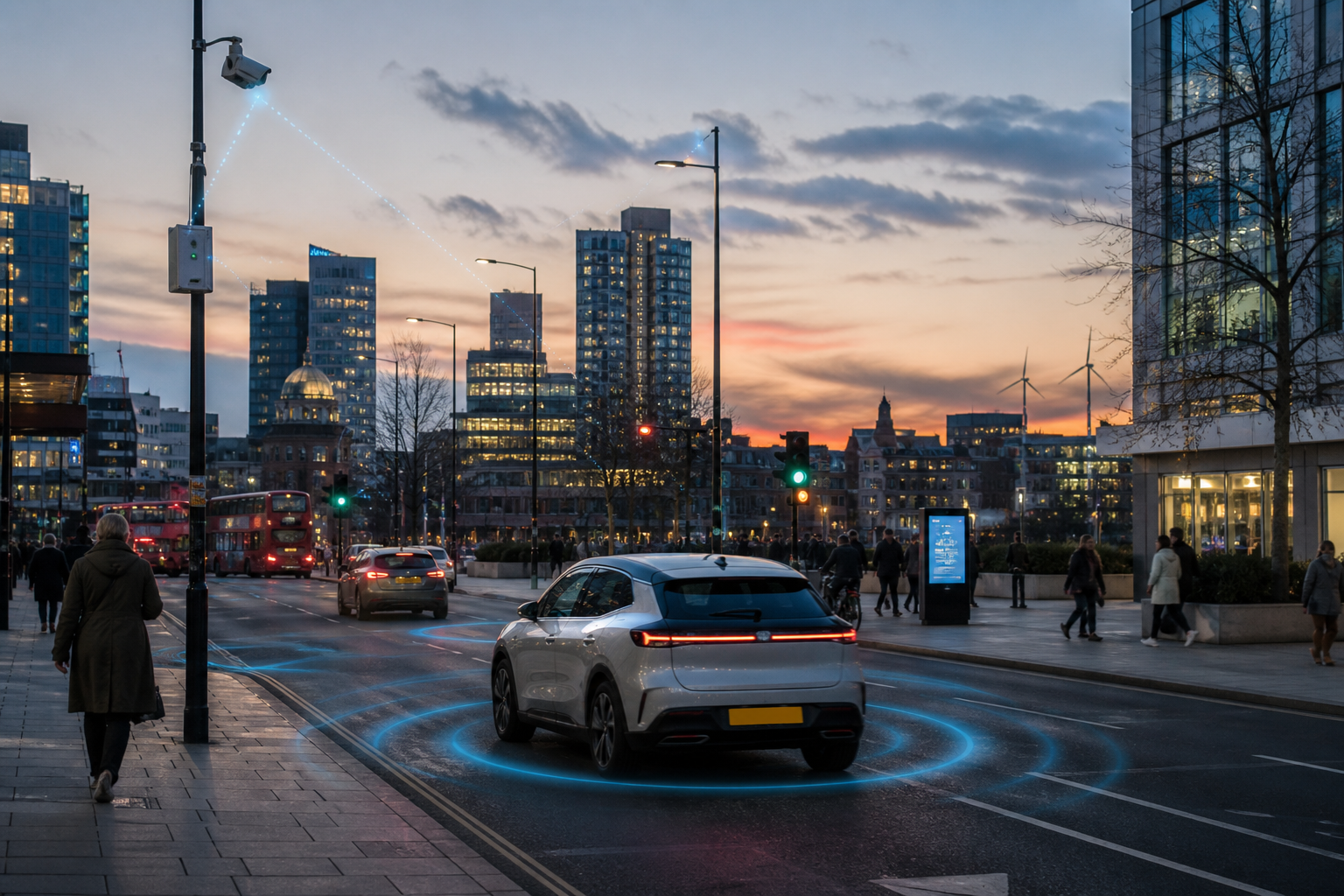
Connected and intelligent vehicles could provide computing power, sensors, communications and battery storage for future smart city services, according to research led by Cardiff Metropolitan University.
The study proposes a framework called Connected and Intelligent Vehicular Systems as Resources (CI-VSaR). It is designed to allow cities to use capabilities already embedded in modern vehicles, rather than treating them solely as transport assets.
Vehicles tested as city resources
Potential applications identified by the researchers include traffic management, environmental monitoring, public safety, emergency communications, energy storage and distributed computing. The approach could apply to connected, autonomous and electric vehicles.
Researchers tested the framework through simulations involving 1,000 vehicles operating in a smart city environment. The system identified available resources, allocated them to tasks and maintained high levels of service quality. The team said further testing in real-world conditions would be needed.
Professor Issam Damaj, head of computer science at Cardiff Metropolitan University, said: “Modern vehicles contain a remarkable range of technologies that are often underused. Our research shows that by treating vehicles as part of a broader smart city ecosystem, we can unlock capabilities that support citizens, communities and public infrastructure.”
He added that the framework was designed to balance technological performance with human needs and expectations.
The research team comprised Professor Damaj and Dr Fiona Carroll of Cardiff Metropolitan University, Professor Mehmet E. Aydin of the University of the West of England, Abdallah H. Salem of Beirut Arab University, and Professor Omer Rana of Cardiff University.