

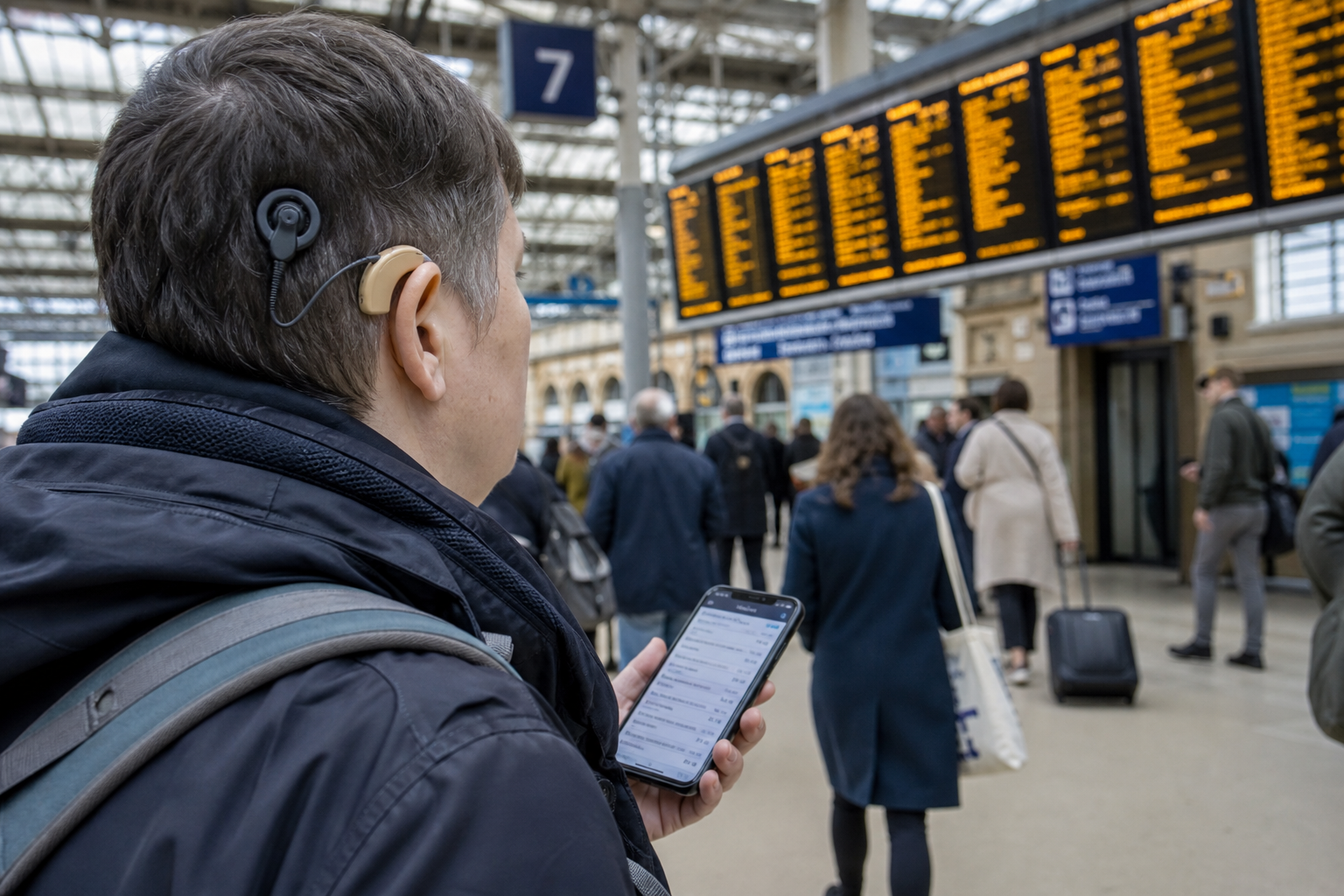
People who are deaf or have hearing loss are being excluded from public transport by inaccessible information and inconsistent staff support, according to a new report from RNID.
The charity’s Clear Signals report says 77% of people with hearing loss who use public transport experience accessibility barriers across trains, buses, metro systems, domestic ferries and trams.
RNID represents the 18 million people in the UK who are deaf, have hearing loss or tinnitus. It said the findings show that difficulties with everyday journeys can have consequences extending beyond the transport network, including reduced independence, anxiety and restrictions on work and social activities.
Information barriers
Among those surveyed, 41% said accessibility barriers limited their independence, while 35% said they avoided public transport whenever possible.
Inaccessible travel information was identified as a major source of stress. Some 76% of deaf and hard-of-hearing passengers, and 81% of British Sign Language users, said it made travelling stressful. Nearly four in five respondents, or 79%, said they felt they needed to remain ‘on alert’ during journeys.
The report also found that 68% of respondents over-prepared for journeys and 83% allowed extra time because they could not rely on information being accessible when they travelled.
RNID said passengers faced particular difficulties when announcements were made only over public address systems, when services changed unexpectedly and when staff lacked deaf awareness. Respondents described journeys as stressful, overwhelming and chaotic, with some stopping their use of public transport altogether.
Calls for coordinated action
Funded by the Motability Foundation, the report is described by RNID as the first published research focused specifically on the real-life experiences of deaf and hard-of-hearing people using public transport in the UK.
RNID is calling on governments, regulators, transport authorities, operators and manufacturers to take coordinated action. Its recommendations include consistent legal requirements for accessible audio information, investment in trials of technologies such as Auracast, and the involvement of people with lived experience in testing and evaluation.
The charity also wants accessibility improvements embedded in national and local transport plans, complaints procedures made accessible to BSL users and universal deaf-awareness training for public-facing staff.
Victoria Boelman, RNID’s director of insight and policy, said: “Our report clearly shows – for the first time – the extent to which travel inequality in the UK means deaf people are having their freedom undermined, and face unacceptable and unnecessary stress and anxiety simply to get from A to B.”
She added: “Now is the time for coordinated action from the Government and transport sector, so everyone has the opportunity for safe and independent travel.”
Nigel Fletcher, chief executive of the Motability Foundation, said the research confirmed concerns raised by disabled people that the transport system was not working for them.
“Opportunity, independence and freedom are thwarted when buses don’t stop, platforms aren’t accessible or digital travel tools don’t work for you,” he said.
Passengers describe uncertainty
Charlotte Young, 44, from Carlisle, who has hearing loss and wears a cochlear implant, said travelling alone could be “quite nerve-wracking” because of uncertainty around announcements and changes to train times.
Emily Forrington, 49, from Cardiff, has severe-to-profound hearing loss in her right ear and no hearing in her left. She said unfamiliar routes and announcements over tannoys were particularly stressful, while unexpected comments from bus drivers could cause panic.
“Accessible information has improved in recent years through smartphones and transport apps, but ‘on the spot’ situations like the bus driver unexpectedly saying something makes me nervous and I unnecessarily panic,” Forrington said.